 A Lean Journey
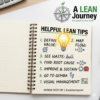
For my Facebook fans you already know about this great feature. But for those of you that are not connected to A Lean Journey on Facebook or Twitter I post daily a feature I call Lean Tips. It is meant to be advice, things I learned from experience, and some knowledge tidbits about Lean to help you along your journey. Another great reason to like A Lean Journey on Facebook.
Although every improvement project has its own unique data, it is useful to know of some metrics that can be utilized in your observations to quantify results. You will want to measure these things early in a project and then again once improvements have been made to determine the impact. If the process being measured requires a lot of time and work, try measuring a sample first.
In data collection, impartial observations of how the process is currently running are critical in identifying waste with respect to time, materials, etc. You can observe a lot by simply watching, although in some environments it may be difficult to observe the work itself. This is because there are so many work products that are virtual, for example, emails, phone, computer inputs and reports. In these cases, process observation is often implemented on a one-on-one basis with volunteers and trained observers.
A library will take a little budget, but books aren’t that expensive. By starting a library, you can fill it with books that have influenced you. When your people read these books, they are learning what influenced you and what you think is important in the business.
Find a select group of forward-looking leaders in the organization and ask them to volunteer to be mentors. Then find some of your high-potential employees or “at-risk” employees and ask them if they would participate in a mentoring program, if you could help them find the right mentor. Start informally and track successes. Share those successes and grow the program slowly. The trick is not to get overwhelmed with a big initiative. Get some small wins to gain traction.
Critical thinking is an important life skill. Reading and taking other people’s word for things doesn’t add much richness to our own life experience and in fact much of what we read or are told is simply not true in certain circumstances. Doing things and experimenting allows you to question the status quo, discover new things, new methods but most importantly critical thinking increases your odds of not clinging to a false belief.
When making change the pitch for the business is likely centered on increasing productivity/efficiency, increasing profit and saving money. Those affected by change want a more basic understanding of the change than that. Answer the, “What’s in it for me?” question and you will never have to sell the change.
People are not interested in increasing the complexity of their processes. However, at a management level, people are interested in less returned product, better throughput from the same resources, and stronger margins from increased efficiency. Talking in terms of the results which managers are accountable for will help them make change a priority.
For example if there is a time during each shift where your machines have to go down for maintenance see if you can have your employees do something else to improve production. For example have them clean up the work area. This will help make sure that everything is organized and where it needs to be so people won’t waste time looking for certain tools which in return will help your productivity time.
Employees need to feel appreciated and part of the company to make them want to do their job the best they can. If you keep your employees happy you will usually have more loyal and productive employees than if they feel like they are just a number that can be replaced.
If you do not know where to start when it comes to implementing lean manufacturing you might want to think about asking for help. Lean manufacturing consultants can help you design a different system the will help your company be more organized. Being more organized will help your company run smoother and be able to make the little changes here and there.
Value stream mapping is a process mapping tool that can be used to evaluate and understand the flow of information and materials within your organization. It’s equally suited to manufacturing and service organizations and through its use of data can provide an accurate picture of the state of your business, showing you the good and the bad – an ideal start point for any lean program.
The seven wastes are a concept of categorizing business inefficiencies. They are Defects, Over-production, Waiting, Transportation, Inventory, Motion, and Excess Processing. By analyzing your business processes and targeting reduction within each category of waste, efficiency gains can be achieved and your business streamlined.
Eradicating errors is crucial to any business. Errors cost money and impact customer satisfaction. By introducing simple measures to trap and stop errors organizations can not only save costs but also become more efficient. Poka Yoke is the concept of error proofing through using visual aids – and what’s more its quick and easy to implement.
With the premise that everything in the workplace has its place – 5S is a business tool that aims to install and maintain a clean and standardized workplace, ensuring that only when things are required are they bought into the work area. By improving the workspace the business lays a foundation for future improvement programs.
Pull systems such as Kanbans help reduce the number of items in work in progress. The various stages of the production process aim to pull resources along the production line so for example as inventory is consumed just enough inventory is replaced to meet the task in hand. Pull systems also aim to eliminate variation in lead times and batch sizes.
Stay connect to A Lean Journey on our Facebook page or LinkedIn group.
Follow me on Twitter or connect with me on Linkedin.
You can also subscribe to this feed or email to stay updated on all posts.


Leave a Comment
Your email address will not be published. Required fields are marked with *