 A Lean Journey
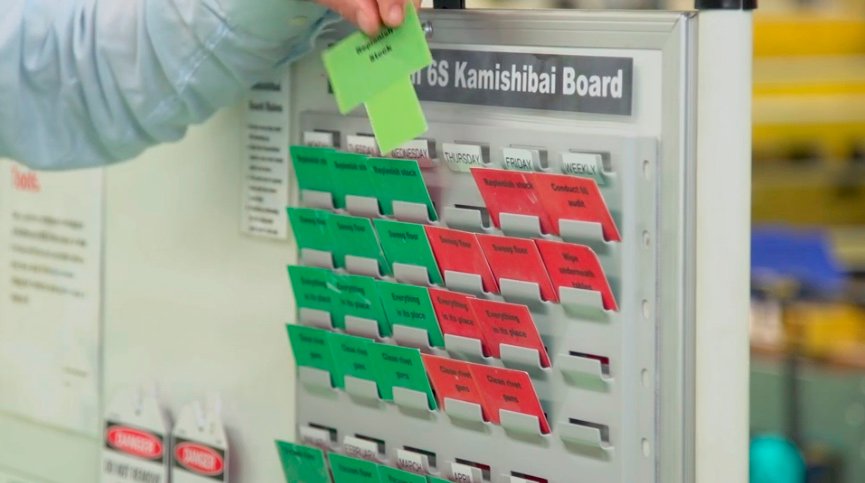
If you’ve spent time in a Toyota-style Lean environment, you may have seen a simple board filled with colored cards hanging near the production area. This visual tool — the Kamishibai board — may look unassuming, but it’s one of the most powerful ways to build consistency, accountability, and engagement into Leader Standard Work (LSW) and Layered Process Audits (LPAs). Today, more organizations are rediscovering Kamishibai as a foundational mechanism for sustaining daily management and reinforcing a culture of continuous improvement.
What Is a Kamishibai Board?
A Kamishibai board is a visual control used to manage routine checks, audits, and standard activities. Each card represents a specific task — for example, safety checks, 5S audits, process confirmations, coaching activities, or equipment observations. Traditionally, one side of the card indicates the task is “not yet completed” (often red), and the opposite side indicates “completed” (often green). Leaders pull cards on a predetermined frequency and physically flip them when the task is done.
This visual simplicity allows teams to immediately see:
- What tasks need to be done
- Who is responsible
- What has been completed
- Where follow-up is still required
It transforms abstract checklists into a live, transparent system aligned with Lean principles of visual control and standardization.
Benefits of Using Kamishibai for Leader Standard Work & LPAs
Kamishibai boards, when integrated into LSW and LPAs, offer powerful benefits:
- Reinforces Consistency and Discipline
Daily, weekly, and monthly tasks become visible and routine, reducing the risk of leaders “walking by” variation without noticing.
- Drives Accountability
Everyone can see whether tasks were completed. A missed card isn’t about blame — it’s a signal that help, coaching, or problem-solving may be needed.
- Creates Engaging Process Confirmation
Leaders don’t just audit; they connect with team members, ask questions, and reinforce expectations.
- Strengthens Layered Audits
By cycling through tasks at multiple leadership levels, the system ensures standards are validated frequently and gaps are escalated early.
- Makes Abnormalities Obvious
A card not flipped is a visual trigger that something isn’t right. This prompts immediate countermeasures rather than delayed responses.
- Supports Continuous Improvement
What leaders learn from Kamishibai audits becomes fuel for kaizen, coaching opportunities, and standard updates.
How to Use a Kamishibai Board Effectively
A well-run Kamishibai process doesn’t rely on luck — it relies on good habits and thoughtful design. Here’s how to make the most of it:
- Define the Tasks Clearly
Each card should have:
- A short description
- The standard or procedure being confirmed
- Expected frequency
- Specific questions or focus points
Avoid vague, generic tasks — clarity ensures quality.
- Pull the Cards, Don’t Pick Your Favorites
Random selection keeps the audits honest and prevents leaders from gravitating toward “easy” checks. Rotation ensures broad coverage of all processes.
- Go See the Work (Genba)
Kamishibai is not a desk audit. Leaders must observe the process, talk to operators, and confirm actual conditions vs. expected standards.
- Document Issues Immediately
If something is out of standard:
- Capture the concern
- Communicate it with the team
- Assign ownership
- Track corrective actions visibly
The point isn’t just to find issues but to close the loop.
- Review Progress Regularly
In daily huddles or weekly leadership meetings, review missed cards, trends, and systemic findings. Patterns often point to deeper opportunities for improvement.
How to Implement Kamishibai in Your Organization
Introducing a Kamishibai system doesn’t require expensive software — only clarity, consistency, and leadership commitment.
Step 1: Start with a Pilot Area
Choose a stable area with engaged supervisors. This builds success, confidence, and learning before scaling.
Step 2: Define the Leader Standard Work
Identify the essential checks that support safety, quality, delivery, and morale. Align the tasks with existing LSW routines and LPA requirements.
Step 3: Create the Cards
Use color-coded, durable cards. Include:
- Task description
- Frequency
- Standard to verify
- Space for quick notes if needed
Keep them concise but helpful.
Step 4: Build the Visual Board
A simple magnetic or slotted board is enough. Organize cards by frequency (daily, weekly, monthly) or by category (5S, safety, quality, coaching).
Step 5: Train Leaders
Focus on:
- How to conduct a good process confirmation
- How to engage team members respectfully
- What “good” looks like
- How to escalate gaps
Skill-building matters more than the board itself.
Step 6: Practice and Adjust
Run the system for a few weeks, gather feedback, and refine:
- Are tasks too vague?
- Too many? Too few?
- Are corrective actions closing?
The Kamishibai board is a living system — adjust it as processes mature.
Step 7: Integrate with Daily Management
Tie Kamishibai findings into your:
- Tiered meetings
- KPI boards
- Problem-solving routines
- Coaching and development
This ensures the work drives behavior and improvement.
A Simple Tool That Builds Strong Habits
Kamishibai boards help leaders move from firefighting to disciplined process confirmation. They connect leadership behaviors with frontline operations and ensure standards don’t just exist — they’re lived. When used well, Kamishibai becomes far more than a board of colored cards. It becomes a cultural anchor for leader standard work, layered audits, and continuous improvement.




Leave a Comment
Your email address will not be published. Required fields are marked with *