 A Lean Journey
Few leadership practices are talked about more—and practiced less effectively—than the Gemba walk.
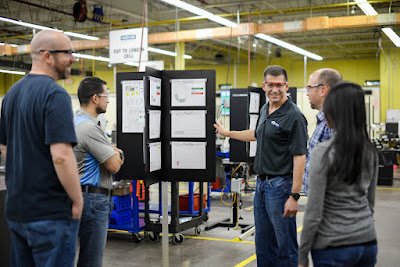
“Gemba” is a Japanese term meaning the actual place. In Lean thinking, it refers to where value is created: the shop floor, the hospital unit, the engineering lab, the service desk. A Gemba walk is when leaders go to that place to observe, learn, and engage.
Done well, Gemba walks build trust, surface problems, and improve systems. Done poorly, they become drive-by inspections that create anxiety and add little value.
The difference isn’t the walk itself—it’s the intent and behavior of the leader.
The Purpose of a Gemba Walk
A Gemba walk is not an audit.
It is not a performance review.
It is not about catching people doing something wrong.
The true purpose of a Gemba walk is to:
- Understand how work is actually done (not how it’s documented)
- See problems in the system that metrics hide
- Learn from the people closest to the work
- Strengthen problem-solving capability
- Demonstrate respect for people
Taiichi Ohno famously drew a chalk circle on the floor and made leaders stand in it for hours—not to punish them, but to teach them how to see. Gemba walks develop that same muscle: the ability to observe deeply and think systemically.
Why Gemba Walks Are a Critical Leadership Technique
Most organizational problems are invisible from conference rooms.
Dashboards lag reality. Reports sanitize complexity. PowerPoint removes context. The Gemba restores it.
Effective Gemba walks help leaders:
- Close the gap between strategy and execution
- Identify waste, overburden (muri), and unevenness (mura) firsthand
- Build credibility by showing up consistently
- Shift from managing by results to managing by process
- Create psychological safety by listening before acting
In Lean organizations, leadership is not defined by how many answers you have—but by how well you help the organization learn.
Gemba walks are how that learning begins.
Gemba Walk Do’s
- Go with humility
Assume you don’t fully understand the work—because you don’t. The people doing the work are the experts. - Observe before asking
Watch the flow. Notice handoffs, delays, workarounds, and signals. Let the work speak first. - Ask open-ended questions
Good questions sound like:
- “What makes this work hard?”
- “Where do things break down?”
- “What gets in your way of doing this right the first time?”
- Listen more than you talk
Silence creates space. Space creates insight. - Focus on the system, not the person
If something looks wrong, assume the process—not the individual—needs improvement. - Follow up
If issues are raised, close the loop. Nothing kills trust faster than problems that disappear into leadership notebooks.
Gemba Walk Don’ts: What Leaders Must Avoid
During early Lean transformations, leaders were explicitly encouraged not to become the following. These traps still show up today—and they derail Gemba walks fast.
The No Show
If you say you’re going to be there, you must be there.
Cancelled or inconsistent walks send a clear message: this isn’t really important. Trust erodes quickly otherwise.
The Riddler
Rapid-fire questioning interrupts work and signals interrogation, not curiosity.
Gemba is not a cross-examination—it’s a conversation.
The Creeper
Silently hovering behind someone all day makes everyone uncomfortable.
Observe respectfully and engage transparently.
The Know-It-All
Demonstrating how you would do the work undermines respect for those who do it every day.
Your role is to learn, not to show off experience from years ago.
The Speed Walker
Flying through the Gemba defeats the purpose of observation.
If you’re in a hurry, you’re not doing a Gemba walk—you’re doing a hallway tour.
The Mindfully Preoccupied
Being physically present but mentally elsewhere sends a clear message.
Phones down. Eyes up. Presence matters.
The Reactor
Overreacting to what you see creates fear and mixed signals.
Not every issue needs immediate action. Some need understanding first.
The Real Measure of a Gemba Walk
A successful Gemba walk isn’t measured by how many problems were pointed out—it’s measured by:
- How safe people felt speaking up
- How much clarity leaders gained about the system
- Whether learning continued after the walk
- Whether trust increased instead of declined
Gemba walks are not about doing more walking.
They are about leading differently.
When leaders consistently go to the Gemba with curiosity, humility, and respect, they don’t just see the work more clearly—they create organizations that learn, adapt, and improve every day.




Leave a Comment
Your email address will not be published. Required fields are marked with *