 A Lean Journey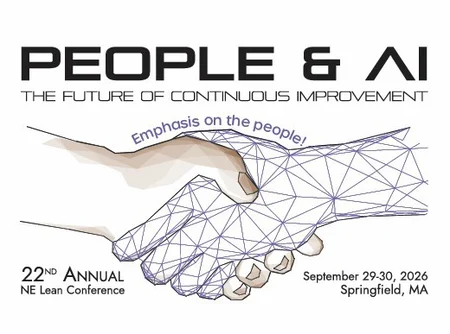
The Northeast Lean Conference brought together Lean practitioners, leaders, and improvement professionals to explore the theme “People & AI: The Future of Continuous Improvement.” Hosted by the Greater Boston Manufacturing Partnership (GBMP), the conference explored how organizations can combine Lean thinking, people development, and artificial intelligence to improve the way work gets done. As someone who has spent much of my career implementing Lean and developing a culture of continuous improvement, I was particularly interested in what AI means for the future of operational excellence. My biggest takeaway was that while AI is changing what is possible, the fundamentals of Lean remain essential: understand the work, solve problems at their source, develop people, and improve processes before trying to automate them.
- Lean Intelligence — Dr. Nada Sanders
Dr. Nada Sanders explored the relationship between human intelligence, artificial intelligence, and decision-making in an increasingly complex business environment. One important takeaway was that AI can help organizations recognize patterns, explore scenarios, and process information faster, but those capabilities do not eliminate the need for human judgment. Leaders still need to understand the context, challenge assumptions, and make decisions that reflect the organization’s purpose and priorities. For me, the lesson is that intelligence is not simply about having more data or better technology. It is about combining information, experience, sound processes, and human judgment to make better decisions.
- AI Takes Real Work: Why Lean Matters More Than Ever — John Soderberg, Fastenal
John Soderberg’s presentation reinforced an important principle: AI takes real work, and that work begins long before the technology is implemented. Organizations need to understand their processes, establish reliable data, clarify ownership, and address the problems that make work difficult in the first place. This resonated with my experience in continuous improvement. Too often, organizations look to technology for a quick solution without first understanding the current state. Automating an inefficient process can simply make the waste happen faster. My takeaway was that successful AI adoption requires the same discipline as a Lean transformation: go see the work, understand the problem, improve the process, and then determine where technology can add value. AI implementation is not a shortcut around continuous improvement; it is another reason to practice it.
- An AI Agent as Your Improvement Partner — Edge Coble, Analog Devices
Edge Coble demonstrated how an AI agent can serve as a partner in structured problem-solving and continuous improvement. Rather than treating AI simply as a tool for generating content or answering questions, organizations can explore how it might help people organize information, challenge assumptions, and work through a problem-solving methodology. The key is to give the AI a clear purpose, relevant context, and a defined process to follow. I see potential in using AI to support Lean practitioners as they develop problem statements, examine potential causes, and think through countermeasures. However, an AI agent should support the problem solver, not replace the problem solver. The person closest to the work must remain accountable for understanding the problem and validating the solution.
- AI-Powered Logistics — Lauren Human and Derek Moldick, Kenco
Lauren Human and Derek Moldick discussed the application of AI in logistics, highlighting opportunities to improve how supply chain and warehouse activities are planned and executed. Applications such as predictive analysis, resource planning, and improved operational visibility can help organizations make more informed decisions and respond more effectively to changing conditions. The important question is not simply whether AI can be applied to logistics, but whether its use produces measurable improvements in service, productivity, quality, cost, or flow. Technology must be connected to business needs and operational performance. As with any improvement initiative, organizations need to define the problem, establish a baseline, and determine whether the solution is delivering the intended results.
- AI Is Not the Enemy of Lean — Priyankkumar Patel
Priyankkumar Patel challenged the idea that AI and Lean are competing approaches to improvement. Instead, AI can complement Lean when it is applied with the right mindset and supported by sound processes. Lean emphasizes customer value, standardized work, problem-solving, quality at the source, and respect for people. These principles are just as relevant when introducing AI as they are when improving a manufacturing process. In fact, the need for verification, clear standards, and accountability becomes even more important when organizations rely on AI-generated information. My takeaway is that the goal should not be to choose between Lean and AI. It should be to use Lean thinking to guide how AI is introduced, evaluated, and improved.
- Gemba Before Algorithms — Paul Ducey, Solar Cannabis Co.
Paul Ducey’s presentation brought the discussion back to one of Lean’s most enduring practices: going to the gemba to understand the actual work. AI can help analyze information and identify potential patterns, but those patterns still need to be understood in the context of the process where the work happens. Data may not tell the whole story, and an apparent problem may have causes that are only visible when observing the work and talking with the people who perform it. The lesson is straightforward: do not let the availability of technology replace direct observation. Start with the people doing the work, understand their challenges, and then consider whether AI can help address them. The gemba remains an essential part of effective problem-solving, even in an increasingly digital workplace.
- W.A.I.T. Before You Act: Using AI Prompt Engineering to Reinforce A3 Thinking — Eric Dickson, MD, UMass Memorial Health
Eric Dickson’s presentation was one of the sessions that particularly stood out to me because it connected AI with the discipline of Lean problem-solving. The W.A.I.T. approach—Who, A3, Interview, Task—provides a structured way to think about what we are asking AI to do before jumping straight to an answer. Rather than immediately prompting AI to generate a solution, we can use it to clarify the problem, ask questions, gather context, and organize our thinking around the A3 process. This reinforces an important Lean lesson: resist the urge to move directly to countermeasures before understanding the problem. I see real value in using AI to help people ask better questions and strengthen their problem-solving discipline. The technology can help structure the thinking, but people still need to verify the facts, engage the right stakeholders, and test countermeasures through a Plan-Do-Study-Act (PDSA) cycle. For me, this is a practical example of using AI to reinforce Lean thinking rather than bypass it.
- Applying Lean Before AI in Functions That Believe They’re Exempt — Tom Stirling, Stirling Brandworks
Tom Stirling brought Lean thinking into the world of marketing and other business functions that may not traditionally see themselves as candidates for process improvement. His presentation was a useful reminder that waste, delays, unclear requirements, rework, and inefficient handoffs are not limited to manufacturing operations. They exist in administrative, professional, and creative work as well. Before applying AI to generate content or accelerate activities, teams need to understand their workflows, clarify what customers need, and identify where time and effort are being lost. AI may help with specific tasks, but it cannot automatically resolve unclear priorities or a poorly designed process. The lesson applies across an organization: Lean is not just a manufacturing methodology, and every function should consider how improving the work itself can create better results before introducing automation.
- Leveraging AI to Build High-Performing, High-Engagement Work Cultures — Jamie Bonini, Toyota Production System Support Center
Jamie Bonini explored the relationship between technology, leadership, and the development of high-performing, engaged work cultures. The Toyota Production System has always emphasized developing people alongside improving processes. That principle remains important as organizations introduce digital tools and AI. Technology should help people solve problems, improve their work, and deliver greater value—not simply remove people from the process or add another layer of complexity. Leaders have an important role in creating an environment where employees can learn, experiment responsibly, and contribute ideas for improvement. The key takeaway is that a high-performing culture does not emerge from technology alone. It requires leadership, clear expectations, employee involvement, and a commitment to developing people’s capabilities.
- Strategy and Metrics: Focus on Measures That Drive Action — Scott Johnson
Scott Johnson’s presentation focused on the relationship between strategy, performance measures, and action. Organizations can collect enormous amounts of data, but more metrics do not necessarily lead to better decisions. Effective measures help people understand whether the process is performing as expected, identify gaps, and determine what action is needed. This is particularly relevant as AI makes it easier to analyze data and produce dashboards or reports. The challenge is to ensure that the information being generated supports the organization’s priorities and leads to meaningful improvement. Measures should connect strategy to daily work, distinguish between results and the activities that influence those results, and prompt investigation when performance changes. AI may make information easier to access, but leaders still need to decide what matters and ensure that metrics lead to problem-solving rather than simply more reporting.
Bringing Lean and AI Together
Attending the Northeast Lean Conference reinforced my belief that AI has significant potential to support continuous improvement, but its value depends on how thoughtfully we apply it. Across the presentations, a consistent message emerged: understand the work before automating it, use technology to strengthen problem-solving, keep people involved, and measure results rather than activity. The sessions on AI Takes Real Work and W.A.I.T. Before You Act particularly reinforced the importance of being deliberate. We need to do the real work of understanding problems, improving processes, and developing people if we want AI to deliver sustainable benefits. For Lean practitioners, the opportunity is not to abandon proven principles in favor of new technology. It is to use those principles to help organizations adopt AI in ways that improve both performance and the experience of the people doing the work.
I am already looking forward to next year’s Northeast Lean Conference, which will take place September 30 and October 1, 2027, in Manchester, New Hampshire, under the theme “Methods & Mindset: Uniting Lean Tools & Culture.” That theme points to another important part of the continuous improvement journey: tools and methods matter, but they are most effective when supported by the right mindset and culture. Conferences like this provide an opportunity to learn from others, challenge our assumptions, and bring new ideas back to our own organizations. I look forward to continuing the conversation about how we can unite Lean tools, leadership, culture, and emerging technologies to make continuous improvement a daily practice.




Leave a Comment
Your email address will not be published. Required fields are marked with *