 A Lean Journey

Quality plays a central role in how organizations deliver products and services, meet customer expectations, and improve performance. A quality management system provides a structured way to manage processes, monitor results, identify problems, and continually improve how work is performed.
At the foundation of quality management is a set of principles that guide how organizations approach customers, leadership, employees, processes, decision-making, improvement, and supplier relationships.
This article explains the 8 Principles of Quality Management associated with the ISO 9001:2008 framework and shows how they can be applied to support consistent quality and organizational improvement.
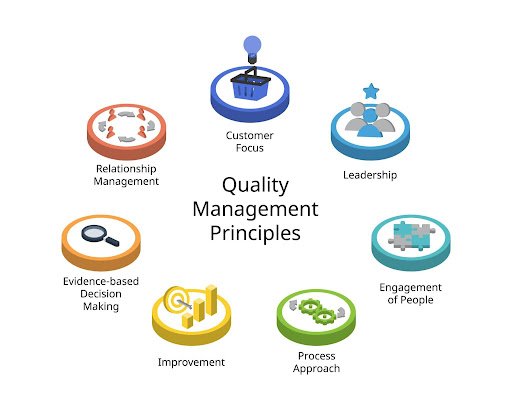
Important: The eight-principle framework discussed in the original article was associated with ISO 9001:2008. The current ISO quality management framework uses seven quality management principles: customer focus, leadership, engagement of people, process approach, improvement, evidence-based decision making, and relationship management. ISO 9001:2026 is now the current edition of the standard.
What Are Quality Management Principles?
Quality management principles are fundamental ideas that help organizations establish, maintain, and improve effective approaches to managing quality.
They provide a foundation for developing a quality management system (QMS) and help organizations connect quality objectives with everyday processes and decisions.
The principles can be applied across different industries and organizational sizes. They are particularly useful for helping leaders think about quality as an organization-wide responsibility rather than something handled only by a quality department. ISO describes these principles as the foundation for quality management systems and continual improvement.
The 8 Principles of Quality Management
The original article’s eight principles reflect the ISO 9001:2008 approach. While the framework has since been updated, these eight concepts remain useful for understanding the historical development of quality management and many practices that continue to influence modern QMS thinking.
| Principle | Core Focus | Practical Application |
| 1. Customer Focus | Understand and meet customer needs | Use customer feedback to improve products, services, and processes |
| 2. Leadership | Establish direction and purpose | Set clear quality goals and create an environment that supports them |
| 3. Involvement of People | Engage employees at every level | Give people opportunities to contribute ideas and solve problems |
| 4. Process Approach | Manage work as connected processes | Define, measure, and improve processes that produce desired results |
| 5. System Approach to Management | Understand how processes interact | Manage related processes as an interconnected system |
| 6. Continual Improvement | Improve an ongoing objective | Identify problems, eliminate causes, and improve performance |
| 7. Factual Approach to Decision Making | Use reliable information | Base decisions on relevant data and analysis |
| 8. Mutually Beneficial Supplier Relationships | Build productive supplier partnerships | Work collaboratively with suppliers to create long-term value |
1. Customer Focus
Organizations depend on their customers, making customer needs a central part of quality management.
Customer focus means understanding both current and future customer requirements and using that information to improve products, services, and experiences.
Organizations can strengthen customer focus by:
- Listening to customer feedback
- Monitoring customer satisfaction
- Understanding changing expectations
- Identifying recurring customer problems
- Connecting customer needs to improvement efforts
- Measuring whether products and services meet requirements
Quality is ultimately judged by the value customers receive. A strong quality management approach therefore keeps customer expectations connected to organizational decisions.
2. Leadership
Quality improvement requires clear direction from leadership.
Leaders establish priorities, communicate expectations, and create the environment in which employees can contribute to organizational objectives.
Effective quality leadership includes:
- Establishing clear quality objectives
- Communicating organizational priorities
- Providing appropriate resources
- Supporting employee involvement
- Reinforcing quality expectations
- Demonstrating commitment through actions
Leadership also means creating alignment. Employees need to understand how their work contributes to broader organizational goals.

3. Involvement of People
Quality cannot be created by management alone.
Employees at every level influence processes, customer experiences, productivity, and problem-solving. When people are encouraged to use their knowledge and experience, organizations can uncover improvement opportunities that might otherwise remain hidden.
Practical ways to involve employees include:
- Asking for improvement ideas
- Giving employees appropriate responsibility
- Encouraging cross-functional problem-solving
- Providing relevant training
- Recognizing contributions
- Creating opportunities to share knowledge
Employee involvement also supports a culture where people feel responsible for the quality of their work rather than viewing quality as someone else’s job.
4. Process Approach
The process approach recognizes that desired results are more consistently achieved when activities and resources are managed as connected processes.
Instead of looking at individual tasks in isolation, organizations can examine how work flows from one step to another.
For example, a manufacturing process may involve:
Customer requirement → Product design → Material planning → Production → Inspection → Delivery → Customer feedback
A problem in one part of the flow can affect everything that follows it.
A process-based approach helps organizations identify:
- Process inputs and outputs
- Responsibilities
- Performance measures
- Bottlenecks
- Sources of variation
- Opportunities for improvement
Modern ISO guidance continues to identify the process approach as one of the core quality management principles.
5. System Approach to Management
Individual processes rarely operate independently.
The system approach focuses on understanding how processes interact and how those relationships affect overall organizational performance.
For example, purchasing decisions can affect production, production can affect delivery, and delivery performance can affect customer satisfaction.
Managing these relationships as part of one system can help organizations avoid optimizing one area while creating problems somewhere else.
Leaders should therefore consider:
- How processes interact
- Where one process depends on another
- How changes in one area affect other departments
- Whether organizational objectives are aligned
- Where system-level improvements can create greater value
This systems perspective is closely connected to the process-oriented thinking used in modern quality management.
6. Continual Improvement
Improvement should not be treated as a one-time project.
Organizations operate in changing environments, and customer expectations, technology, processes, and business conditions continue to evolve. A commitment to continual improvement helps organizations respond to those changes.
Improvement can involve:
- Reducing defects
- Eliminating unnecessary steps
- Improving process flow
- Preventing recurring problems
- Reducing waste
- Improving customer satisfaction
- Increasing process consistency
For Lean organizations, this principle is particularly relevant because continuous improvement is central to Lean thinking.
The goal is not necessarily to make dramatic changes every time. Small, consistent improvements can also produce meaningful results over time.

7. Factual Approach to Decision Making
Good quality decisions should be supported by reliable information.
The factual approach to decision making encourages organizations to gather and analyze relevant data before deciding what action to take.
Useful information may include:
- Defect rates
- Customer feedback
- Process performance
- Delivery performance
- Cost data
- Productivity measures
- Audit findings
- Root-cause analysis
Data does not replace leadership judgment, but it provides a stronger foundation for understanding what is actually happening.
Modern ISO terminology refers to this principle as evidence-based decision-making.
8. Mutually Beneficial Supplier Relationships
Suppliers can have a significant impact on an organization’s ability to deliver consistent quality.
A supplier relationship based solely on short-term transactions may overlook opportunities to improve quality, reliability, cost, and performance together.
A mutually beneficial relationship encourages organizations and suppliers to work toward shared objectives.
This can involve:
- Clearly communicating requirements
- Sharing relevant performance information
- Addressing quality problems collaboratively
- Evaluating supplier performance
- Developing long-term relationships where appropriate
- Identifying opportunities for joint improvement
Modern ISO terminology has broadened this concept into relationship management, recognizing that organizations depend on relationships with suppliers and other interested parties.
How Quality Management Principles Support a QMS
A quality management system brings quality-related processes, responsibilities, objectives, and improvement activities together into a structured framework.
ISO 9001 specifies requirements for establishing, implementing, maintaining, and continually improving a QMS. The principles provide the underlying thinking that supports that system.
A practical QMS should help an organization answer questions such as:
- What do our customers expect?
- Which processes affect quality?
- Who is responsible for each process?
- How do we measure performance?
- What problems are occurring?
- What does the data tell us?
- Where can we improve?
- How do suppliers and other relationships affect performance?
The answers create a connection between quality objectives and everyday work.
Quality Management Best Practices
Applying quality principles effectively requires more than documenting procedures. The principles should influence how people work and how leaders make decisions.
Some useful quality management best practices include:
Define Clear Quality Objectives
Make quality expectations specific and measurable. Employees should understand what successful performance looks like.
Measure What Matters
Use meaningful performance indicators rather than collecting data simply because it is available.
Involve Employees
People closest to the work often have valuable knowledge about problems and improvement opportunities.
Focus on Root Causes
When problems occur, look beyond the immediate symptom and investigate why the problem happened.
Listen to Customers
Customer feedback can reveal gaps between what an organization intends to deliver and what customers actually experience.
Improve Processes Continuously
Treat improvement as an ongoing part of daily work rather than an occasional initiative.
Strengthen Supplier Relationships
Work with suppliers to address recurring issues and identify opportunities to improve quality across the value stream.
From the Eight Principles to Today’s Quality Management Framework
The original article focused on the 8 Principles of Quality Management from ISO 9001:2008. The framework has since evolved.
ISO’s current quality management framework is built around seven principles:
- Customer focus
- Leadership
- Engagement of people
- Process approach
- Improvement
- Evidence-based decision making
- Relationship management
ISO explains that these seven principles underpin ISO 9000, ISO 9001, and related quality management standards.
The change does not mean that the older concepts suddenly became irrelevant. Instead, several ideas were consolidated and updated. For example, the former involvement of people principle is reflected in today’s engagement of people, while the former supplier-focused relationship principle has been broadened to relationship management.
Practical Takeaways for Quality Leaders
Whether you are working with an established QMS or beginning to strengthen your quality approach, these principles provide useful questions for reflection:
- Are customer needs clearly understood?
- Do leaders consistently reinforce quality expectations?
- Are employees actively involved in improvement?
- Are processes understood as connected activities?
- Are decisions supported by reliable evidence?
- Are improvement opportunities addressed systematically?
- Are supplier relationships managed collaboratively?
- Do quality objectives connect to everyday work?
Quality management becomes more effective when these ideas are built into normal business practices rather than treated as separate compliance activities.
Final Thoughts
The 8 Principles of Quality Management provide an important historical foundation for understanding how ISO quality management evolved. Customer focus, leadership, employee involvement, process thinking, continual improvement, data-based decisions, and strong relationships remain central themes in effective quality management.
For organizations today, however, it is important to distinguish the older eight-principle ISO 9001:2008 framework from the current seven-principle approach. ISO’s modern framework emphasizes customer focus, leadership, engagement, process management, improvement, evidence-based decisions, and relationship management.
The underlying lesson remains straightforward: quality is not the responsibility of one department. It is built through the way an organization understands its customers, manages its processes, engages its people, makes decisions, develops relationships, and continually improves.







Leave a Comment
Your email address will not be published. Required fields are marked with *