 A Lean Journey
One of the most common frustrations in continuous improvement is this: teams invest significant time and energy eliminating waste, only to see the same problems return weeks or months later. Inventory creeps back. Lead times stretch. Firefighting resumes.
The issue is not a lack of effort or commitment. The issue is focus.
Most Lean practitioners concentrate almost exclusively on Muda—the visible waste in a process—without adequately addressing Muri and Mura. In doing so, they treat symptoms rather than root causes. Toyota taught us long ago that waste does not exist in isolation. To truly improve a system, we must understand and address all three Ms: Muda, Muri, and Mura.
The 3Ms: Seeing the Whole System
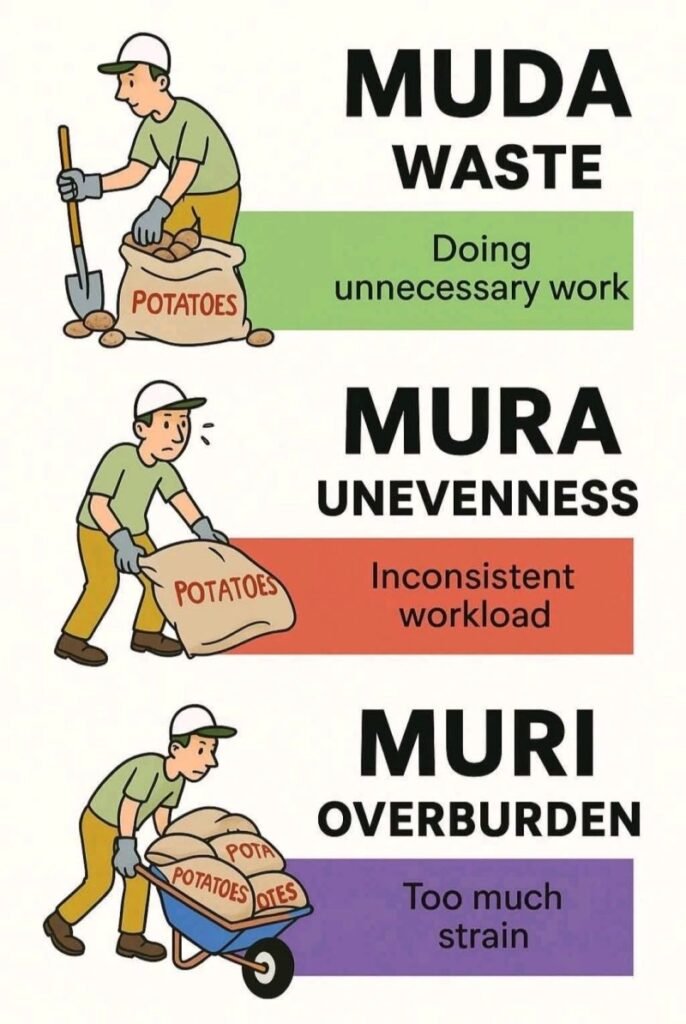
Muda (無駄) – Waste
What it is:
Muda refers to any activity that consumes resources but does not create value from the customer’s perspective.
The classic eight wastes:
Overproduction, Waiting, Transportation, Over-processing, Inventory, Motion, Defects, and Underutilized talent.
Why it gets all the attention:
Muda is easy to see. Excess inventory piles up. People wait for approvals. Rework becomes obvious. Because it is visible and measurable, Muda often becomes the primary target of Lean initiatives.
The problem is not that eliminating Muda is wrong—it is essential. The problem is that eliminating Muda alone rarely lasts.
Mura (斑) – Unevenness
What it is:
Mura is variation or inconsistency in demand, workload, processes, or outcomes.
Common examples:
- Large swings in customer demand
- Irregular production schedules
- Different operators performing the same task in different ways
- Quality that varies by shift or by day
Why it matters:
Mura is a powerful generator of waste. When work arrives in bursts, systems are forced to start, stop, rush, and recover. This creates waiting, excess inventory, expediting, and rework. In many cases, Muda is simply the visible result of unmanaged variation.
Muri (無理) – Overburden
What it is:
Muri is pushing people, equipment, or processes beyond their natural or designed limits.
Common examples:
- Unrealistic production targets
- Chronic overtime
- Machines running beyond rated capacity
- Employees expected to multitask excessively or skip standard work
Why it matters:
Muri leads directly to breakdowns, safety incidents, quality defects, and burnout. When people or machines are overburdened, mistakes are inevitable. Those mistakes then show up as—yes—more Muda.
The Missing Insight: Why Muda Keeps Coming Back
A common saying in Lean is:
“Mura creates Muri, and both generate Muda.”
This relationship is critical, yet often overlooked. Many Lean efforts begin and end with waste elimination workshops, kaizen events, and value stream maps focused on reducing Muda. Meanwhile, uneven demand and overburdened systems remain untouched.
When Muri and Mura are left unaddressed, waste elimination becomes temporary at best. You may remove steps, reduce inventory, or speed up processes, but the underlying conditions that create waste are still present. Eventually, the waste returns—sometimes worse than before.
The Proper Sequence for the 3Ms
One of the most important lessons from Toyota is that the order matters. The 3Ms are not meant to be attacked randomly or simultaneously without thought. There is a natural and effective sequence.
Step 1: Address Muri (Overburden)
Start by ensuring that people and equipment are not being pushed beyond their limits. This means aligning capacity with demand, providing proper training, and ensuring resources are adequate. A system under constant strain cannot improve; it can only survive.
Step 2: Reduce Mura (Unevenness)
Once overburden is addressed, focus on leveling the work. Tools such as heijunka, takt time, and standardized work help create consistency and predictability. Reducing variation stabilizes the system and prevents new problems from being introduced.
Step 3: Eliminate Muda (Waste)
Only after the system is stable should teams aggressively remove waste. At this point, waste elimination efforts are far more likely to stick because the root causes—overburden and unevenness—have already been addressed.
Why This Order Is So Important
Skipping directly to Muda is tempting because it produces fast, visible results. But without addressing Muri and Mura first, those results are fragile. Sustainable Lean improvement is not about working harder or cutting faster—it is about designing systems that are balanced, predictable, and humane.
When you follow the proper sequence of the 3Ms, waste elimination stops being a recurring battle and starts becoming a lasting capability. That is the difference between short-term gains and true continuous improvement.




Leave a Comment
Your email address will not be published. Required fields are marked with *