 A Lean Journey
 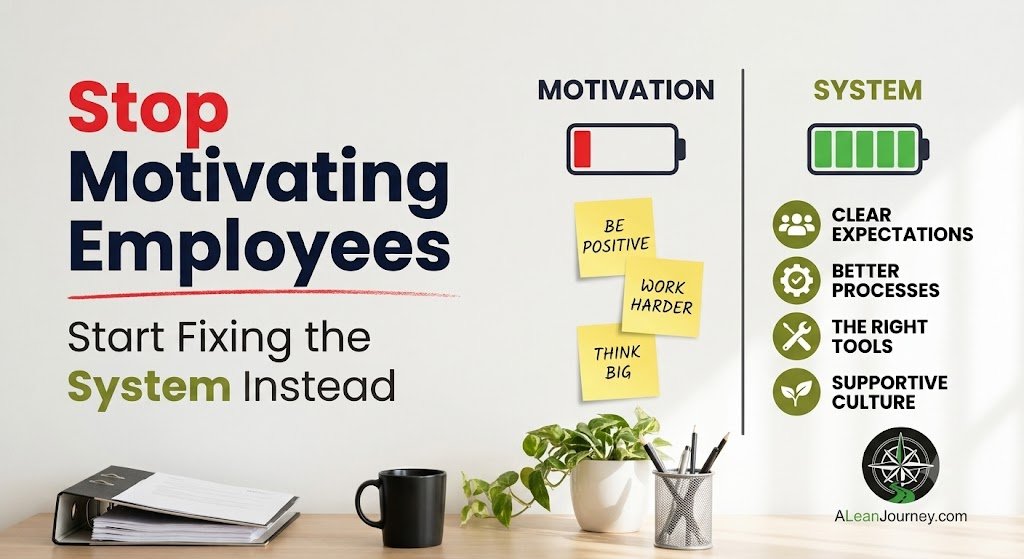 When performance dips after a disruption—whether it’s a holiday break, organizational change, or shifting priorities—many leaders instinctively reach for motivation. Pep talks, incentives, and renewed pressure often follow.
But what if motivation isn’t the problem?
As leadership expert Anne Grady suggests, high-performing teams don’t need to be “motivated” back into action. They need clarity, alignment, and a system that supports performance in uncertain conditions. From a Lean perspective, this distinction matters. Lean has never been about pushing people harder—it’s about improving the system so people can succeed.
Motivation Is a Symptom, Not a Solution
Lean thinking teaches us that results are driven by processes. When performance falters, the root cause is rarely a lack of effort. More often, it’s unclear priorities, conflicting demands, or wasted energy.
Trying to “motivate” people in a broken system is like asking operators to run faster on a poorly designed production line. It may produce a short-term burst, but it’s not sustainable—and often leads to burnout.
Instead of asking, “How do I motivate my team?” Lean leaders should ask, “What in the system is making it hard for my team to succeed?”
- Anchor Decisions to Values
In times of disruption, ambiguity increases. Teams spend valuable time debating priorities or second-guessing decisions.
Clear organizational values act as a decision-making framework. In Lean organizations, this is often reinforced through principles like respect for people and continuous improvement. When values are well understood, teams can make aligned decisions without constant escalation.
This reduces hesitation, accelerates decision-making, and keeps work flowing.
- Replace Pressure with Clarity
One of the most common leadership mistakes is increasing pressure when results slow down. But pressure without clarity creates confusion and rework—two forms of waste.
Lean leaders focus on defining:
- What matters most right now
- What success looks like this week
- What can wait
This aligns directly with visual management and daily management systems. When expectations are visible and understood, teams can focus their effort where it matters most.
Clarity fuels flow. Pressure disrupts it.
- Manage Energy, Not Just Time
Traditional management focuses heavily on time utilization. Lean thinking goes deeper by considering human capability and sustainability.
Overburden (muri) is one of the three enemies of Lean. When leaders expect peak performance without protecting team energy, they introduce strain that leads to errors, disengagement, and turnover.
Smart leaders:
- Build in recovery time
- Set realistic workloads
- Encourage boundaries
Sustainable performance always outperforms short bursts of exhaustion.
- Eliminate Noise and Focus on Flow
In many organizations, everything feels urgent. Meetings multiply, priorities compete, and attention becomes fragmented.
This is a classic example of waste—specifically, the waste of overprocessing and task switching.
Lean leaders create focus by:
- Reducing unnecessary meetings
- Limiting work in process (WIP)
- Prioritizing fewer, more impactful initiatives
Momentum doesn’t come from doing more. It comes from improving flow and concentrating effort.
- Normalize Uncertainty
Uncertainty is not new—it’s a constant. What changes is how organizations respond to it.
Lean organizations embrace uncertainty by building adaptable systems and developing problem-solving capability at every level. Instead of waiting for perfect direction, teams are equipped to experiment, learn, and adjust.
When leaders normalize uncertainty, they reduce fear and increase agility.
- Build Ownership, Not Compliance
You can’t force engagement. But you can create conditions where people take ownership.
Lean emphasizes respect for people by involving them in problem-solving and decision-making. When individuals understand the “why” behind their work and have a voice in improving it, they naturally become more invested.
Ownership leads to:
- Faster problem resolution
- Greater innovation
- Stronger commitment to outcomes
This is far more powerful than any external motivation tactic.
From Motivation to Momentum
The key insight is simple but often overlooked:
Clarity creates focus. Priorities create direction. Energy creates momentum.
Motivation is not something leaders need to inject—it’s something that emerges when the system supports success.
For Lean leaders, this is a familiar concept. Our role is not to push people harder, but to remove barriers, reduce waste, and create an environment where people can do their best work.
When you fix the system, motivation takes care of itself.




Leave a Comment
Your email address will not be published. Required fields are marked with *