 A Lean Journey
 On Fridays I will post a Lean related Quote. Throughout our lifetimes many people touch our lives and leave us with words of wisdom. These can both be a source of new learning and also a point to pause and reflect upon lessons we have learned. Within Lean active learning is an important aspect on this journey because without learning we can not improve.
Improving in-season inventory positions requires getting merchandising, planning, supply chain, marketing and other functions to work off “one version of the truth.” It also means aligning these teams around the same critical metrics.
Numerous functions play a role in a retailer’s inventory management—not just the planning or supply chain functions. These functions may have quite different information on what’s selling (or not) and why, when product is due to arrive and when and where it is needed. This lack of common information leads to errant plans and disjointed operations, or simply put, the wrong inventory in the wrong place at the wrong time.
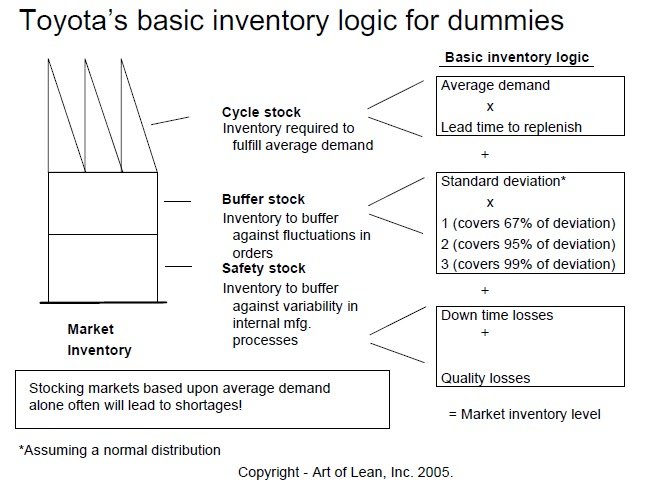
Where you have perfect information, you don’t need any buffer stock. The less reliable information you have, the more inventory you need to hold. On a basic level there are two pieces of information needed: the reliability of the supplier to deliver to you and the stability of the demand from the customer. Inventory is a buffer for fluctuations in these two components of the supply chain.
Art Smalley, President of the Art of Lean, has a great visual explaining the basics of Toyota’s inventory logic:
To improve the information you have about your supply chain these are some questions you can ask:
What is your on time delivery performance?
What is your lead time?
What is your inventory level?
How much time do you spend looking for components?
How good is the quality of your supplier?
What is your supplier’s on-time delivery performance?
Art demonstrates that making improvements in your supply chain with the emphasis on lead-time can have a big impact on inventory.
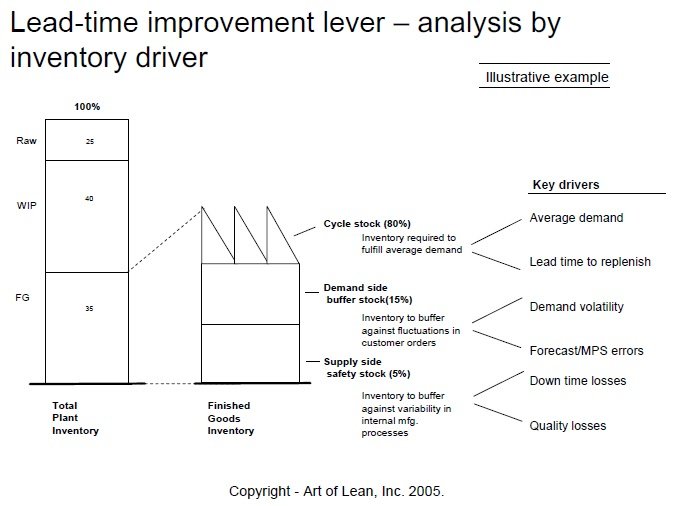
So if you want to reduce your inventory substitute distortions or uncertaninty in your supply chain with good information while continuously improving your cycle time.
Stay connect to A Lean Journey on our Facebook page or LinkedIn group.
Follow me on Twitter or connect with me on Linkedin.
You can also subscribe to this feed or email to stay updated on all posts.




Leave a Comment
Your email address will not be published. Required fields are marked with *