 A Lean Journey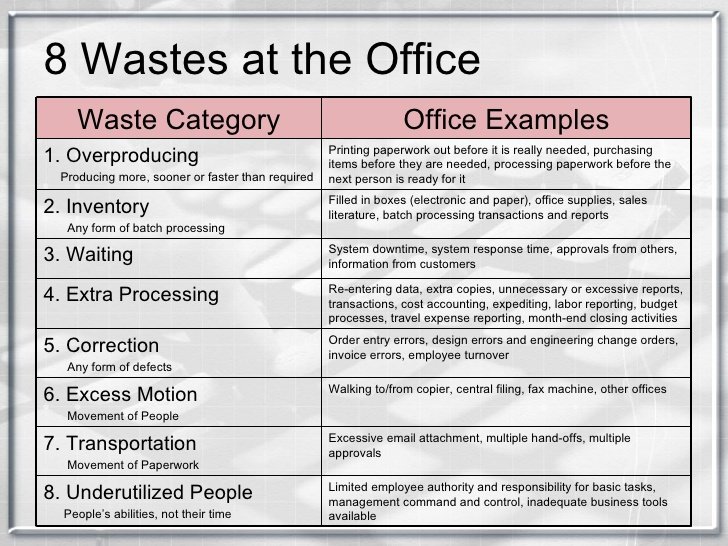
Applying
Lean to office processes is an often misunderstood concept. Many efforts at
lean office often fall by the wayside since measuring improvement is nearly
impossible. It is important to analyze the office processes themselves to
determine how to apply lean appropriately. The best way to accomplish this is
to first understand how the seven wastes of manufacturing apply to office processes
to identify improvement opportunities.
Lean to office processes is an often misunderstood concept. Many efforts at
lean office often fall by the wayside since measuring improvement is nearly
impossible. It is important to analyze the office processes themselves to
determine how to apply lean appropriately. The best way to accomplish this is
to first understand how the seven wastes of manufacturing apply to office processes
to identify improvement opportunities.
To
identify and eliminate the waste that plagues your office, learn to identify
the 8 wastes in their manifestations.
Here is a list of the 8 common wastes of Lean, and some ideas about how
they manifest in the office environment.
identify and eliminate the waste that plagues your office, learn to identify
the 8 wastes in their manifestations.
Here is a list of the 8 common wastes of Lean, and some ideas about how
they manifest in the office environment.
Defects &
Inspection
Inspection
This
is work that you thought was complete but requires to be touched again due to
not meeting the customer’s needs. Inspection is the same as review and this is
in the flow because our internal customer doesn’t trust that we can deliver
what they want. This leads to more reworking of defects, but we have to fix the
process to produce a good product.
is work that you thought was complete but requires to be touched again due to
not meeting the customer’s needs. Inspection is the same as review and this is
in the flow because our internal customer doesn’t trust that we can deliver
what they want. This leads to more reworking of defects, but we have to fix the
process to produce a good product.
Examples:
•
Order
entry errors
Order
entry errors
•
Design
errors or engineering change orders
Design
errors or engineering change orders
•
Invoice
errors
Invoice
errors
•
Lost
files or records
Lost
files or records
•
Bad
or Missing information
Bad
or Missing information
Over Production
This
is the act of producing more than what the customer wants instead of providing
what they need or actually paid for.
This is a fast way to lose customers as it requires more time and
resources, something that is in short supply.
is the act of producing more than what the customer wants instead of providing
what they need or actually paid for.
This is a fast way to lose customers as it requires more time and
resources, something that is in short supply.
Examples:
•
Producing
reports that no one reads or needs
Producing
reports that no one reads or needs
•
Making
extra copies just-in-case
Making
extra copies just-in-case
•
Producing
more to avoid set-ups
Producing
more to avoid set-ups
•
Entering
repetitive information on multiple documents
Entering
repetitive information on multiple documents
•
Memos
or email to everyone
Memos
or email to everyone
Waiting
A
period of time delay spent while expecting something to happen or ready for
something to happen. Waiting waste is idle time created when material, information,
people or equipment is not ready.
period of time delay spent while expecting something to happen or ready for
something to happen. Waiting waste is idle time created when material, information,
people or equipment is not ready.
Examples:
•
Waiting
for approvals or signatures
Waiting
for approvals or signatures
•
Attendees
not all on time for meeting
Attendees
not all on time for meeting
•
Slow
system response time
Slow
system response time
•
Delays
in receiving information
Delays
in receiving information
•
Printer
or computer break-down
Printer
or computer break-down
Non-Utilized People
or Knowledge
or Knowledge
People’s
skill, abilities, and knowledge are not effectively or appropriately used. This
happens frequently in large organizations where the skills and backgrounds of
everyone are not common knowledge. The biggest crime in this category is not
empowering or enabling the people most intimate with a process to improve the
process.
skill, abilities, and knowledge are not effectively or appropriately used. This
happens frequently in large organizations where the skills and backgrounds of
everyone are not common knowledge. The biggest crime in this category is not
empowering or enabling the people most intimate with a process to improve the
process.
Examples:
•
Bypassing
procedures to hire a favorite candidate
Bypassing
procedures to hire a favorite candidate
•
Start
using software without prior training
Start
using software without prior training
•
Not
providing opportunity for professional development
Not
providing opportunity for professional development
•
Limited
authority and responsibility for basic tasks
Limited
authority and responsibility for basic tasks
•
Inadequate
business tools / training available
Inadequate
business tools / training available
Transportation
This
is where you have to take the product you are working on and move it
somewhere. That act of moving does not
change fit, form, or function. We are
usually taking it to the boss to drop it off on their desk be reviewed, so we
can rework it later. I see a pattern
developing here.
is where you have to take the product you are working on and move it
somewhere. That act of moving does not
change fit, form, or function. We are
usually taking it to the boss to drop it off on their desk be reviewed, so we
can rework it later. I see a pattern
developing here.
Examples:
•
Moving
product in and out of storage
Moving
product in and out of storage
•
No
signs identifying areas or departments
No
signs identifying areas or departments
•
Multiple
hand-offs or approvals
Multiple
hand-offs or approvals
•
Bad
area layout
Bad
area layout
•
Excessive
filing of documents
Excessive
filing of documents
Inventory
Inventory
is a common result of multi-tasking and otherwise un-balanced workloads. It can be found in e-mail or work order
in-boxes, to-do lists, product development pipelines, and resource assignment
charts. If a person has three tasks to
complete, it is guaranteed that two of them are waiting (in inventory) while
that person performs the third. If you
want to be able to see inventory like you do on the factory floor, you must
make the lists, in-boxes, resource assignments, and project pipelines visible
in your workspace.
is a common result of multi-tasking and otherwise un-balanced workloads. It can be found in e-mail or work order
in-boxes, to-do lists, product development pipelines, and resource assignment
charts. If a person has three tasks to
complete, it is guaranteed that two of them are waiting (in inventory) while
that person performs the third. If you
want to be able to see inventory like you do on the factory floor, you must
make the lists, in-boxes, resource assignments, and project pipelines visible
in your workspace.
Examples:
•
Excessive
office supplies
Excessive
office supplies
•
Files
piled up between desks
Files
piled up between desks
•
No
storage space because its filled with stuff not needed
No
storage space because its filled with stuff not needed
•
Batch
processing transaction & reports
Batch
processing transaction & reports
•
Obsolete
files or office equipment
Obsolete
files or office equipment
•
No
sufficient cross-training
No
sufficient cross-training
Motion
Excess
motion primarily refers to people having to walk to office equipment or (even
more importantly) having to walk to find people. Meetings are motion in the
sense that they are work without producing, unless a decision is made or
information is produced during the meeting. Motion shows up as people search
for files they can’t find, in phone calls to track down information, or from
unnecessary button clicks to get to the bottom of a work order to update the
to-do list.
motion primarily refers to people having to walk to office equipment or (even
more importantly) having to walk to find people. Meetings are motion in the
sense that they are work without producing, unless a decision is made or
information is produced during the meeting. Motion shows up as people search
for files they can’t find, in phone calls to track down information, or from
unnecessary button clicks to get to the bottom of a work order to update the
to-do list.
Examples:
•
Looking
for items without a defined place
Looking
for items without a defined place
•
Searching
for files on computer
Searching
for files on computer
•
Employees
not working to a standard method
Employees
not working to a standard method
•
Poor
work area layout
Poor
work area layout
•
Sorting
through materials
Sorting
through materials
Excess Processing
Excess
processing often results from the creation of multiple versions of a piece of work
that now must be reconciled into the true work.
It shows up in additional signature approvals, data entry or data format
changes, frequently revising documents or information, or complex forms or
databases that require information to be entered repeatedly.
processing often results from the creation of multiple versions of a piece of work
that now must be reconciled into the true work.
It shows up in additional signature approvals, data entry or data format
changes, frequently revising documents or information, or complex forms or
databases that require information to be entered repeatedly.
Examples:
•
Multiple
signatures
Multiple
signatures
•
Unused
or unnecessary information collected
Unused
or unnecessary information collected
•
Re-entering
data
Re-entering
data
•
Different
software working on same document
Different
software working on same document
•
Expediting
Expediting
•
Unnecessary
or excessive reports
Unnecessary
or excessive reports
My best advice for finding and eliminating waste in
the office is to find what bugs you.
Hunt down the rework, the overtime, the stress and frustration, and you
will quickly begin putting your fingers on the waste and its causes. Address
the causes of the waste. Eliminate
them. In doing so, you will not only
make your business more productive, but it will be a much better place to work.








Leave a Comment
Your email address will not be published. Required fields are marked with *