 A Lean Journey
 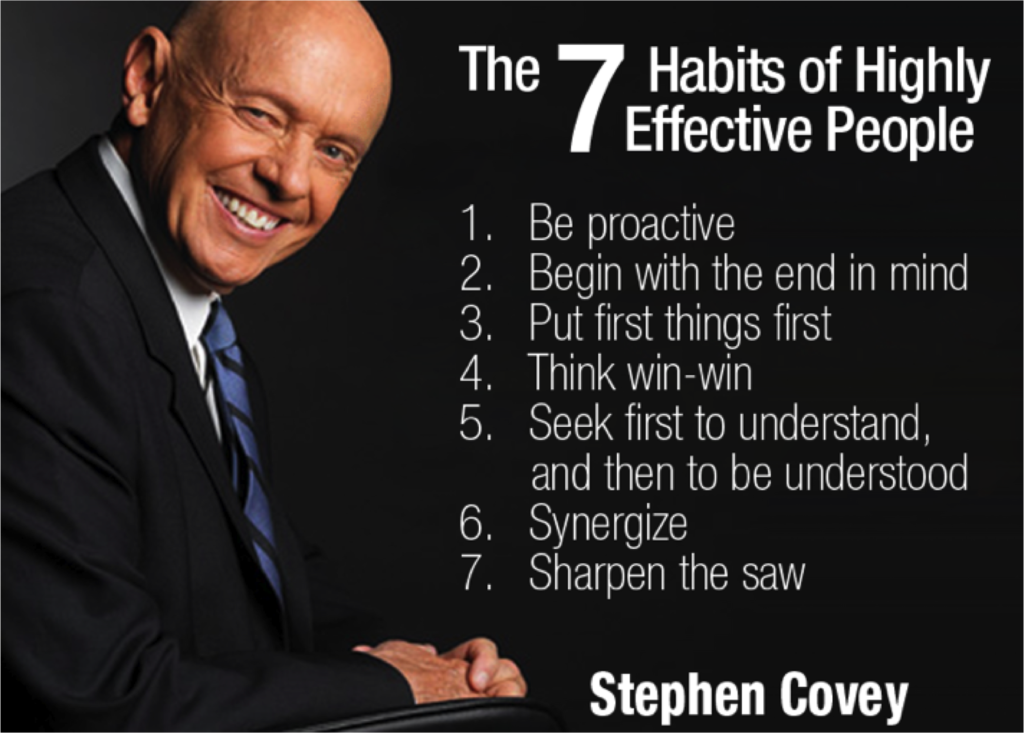 Stephen Covey’s 7 Habits of Highly Effective People helped generations of leaders focus on personal effectiveness. Lean leadership builds on that foundation—but deliberately shifts the focus outward.
Lean asks a different question:
How do our daily habits improve the system and develop the people within it?
Highly effective Lean practitioners don’t succeed because they know more tools. They succeed because their habits shape better thinking, better behavior, and ultimately better systems.
Below are seven habits commonly seen in effective Lean leaders, each intentionally mapped to Covey’s original habits—through a Lean lens.
- Go to the GembaWithIntent
(Covey Habit: Be Proactive)
Highly effective Lean practitioners don’t wait for reports, escalations, or quarterly reviews. They proactively go to the gemba—the place where value is created—to understand reality firsthand.
This habit is not about reacting to problems. It’s about choosing to learn before problems grow. Lean leaders take responsibility for understanding the work, the obstacles, and the conditions people face every day.
Going to the gemba is a proactive act of leadership.
Lean reminder: You can’t improve what you’re unwilling to see.
- Start With Purpose, Not Tools
(Covey Habit: Begin With the End in Mind)
Effective Lean practitioners are clear on why they are improving before deciding how. They align improvement work to purpose, customer value, and organizational direction—rather than jumping straight to tools or events.
This clarity helps teams avoid “random acts of Lean” and keeps improvement grounded in outcomes that matter.
A3s, value stream maps, and kaizen events are means—not ends.
Lean reminder: When the purpose is clear, the right methods follow.
- Improve the System Before Optimizing Yourself
(Covey Habit: Put First Things First)
Lean practitioners understand that effort does not equal effectiveness. Being busy, heroic, or personally efficient means little if the system itself is broken.
Highly effective Lean leaders focus first on stabilizing processes, clarifying standard work, and removing systemic barriers—so people don’t have to compensate with extra effort.
They prioritize work that strengthens the system, even when it’s less visible or less urgent.
Lean reminder: A well-designed system beats individual excellence every time.
- Create Win-Win Improvements
(Covey Habit: Think Win-Win)
Lean practitioners reject the false trade-offs between speed and quality, cost and safety, management and labor.
They design improvements that make work easier and results better. They involve the people closest to the work and respect their expertise, knowing sustainable improvement must work for everyone.
Win-lose changes create resistance. Win-win changes build trust.
Lean reminder: Respect for people is not a slogan—it’s a design principle.
- Listen to Understand the Work
(Covey Habit: Seek First to Understand, Then to Be Understood)
Highly effective Lean practitioners listen far more than they talk—especially at the gemba.
They ask open-ended questions, observe without interrupting, and work to understand the thinking behind current conditions before proposing solutions.
This habit builds psychological safety and surfaces insights no report could ever capture.
Lean reminder: The people doing the work already know where the problems are.
- Learn Through Scientific Thinking
(Covey Habit: Synergize)
In Lean, synergy shows up through shared problem-solving and systems thinking. Highly effective practitioners don’t rely on individual brilliance; they create learning loops that allow teams to think and improve together.
PDCA, A3 thinking, and experimentation align people around a common understanding of the problem and the path forward. The learning is collective, not individual.
When teams solve problems together, the whole becomes greater than the sum of its parts.
Lean reminder: Better thinking emerges when people learn together.
- Sharpen the Organization, Not Just Yourself
(Covey Habit: Sharpen the Saw)
Highly effective Lean practitioners don’t treat improvement as a project or initiative. They embed learning, reflection, and improvement into daily work.
They invest in developing problem-solving capability, reinforcing standard work, and creating space to reflect on what was learned—not just what was achieved.
Over time, this habit builds resilient systems and adaptable organizations.
Lean reminder: Sustainable improvement depends on continually renewing the system.
Final Reflection
Lean success is not driven by maturity models or toolkits. It is driven by habits—what leaders and practitioners do, consistently, in everyday work.
When these habits take root, improvement stops being something you roll out and starts becoming the way the organization thinks, learns, and leads.
Which of these habits are strongest in your organization—and which ones need more deliberate practice?




Leave a Comment
Your email address will not be published. Required fields are marked with *