 A Lean Journey
 Can Lean be represented by a single equation? In simple terms Lean can be defined as the most efficient use of resources in the creation of value for the end customer. Business is about the system or series of processes to satisfy the customer. Processes by definition can be defined. So if Lean is a business system for thinking customer value it can be represented below:
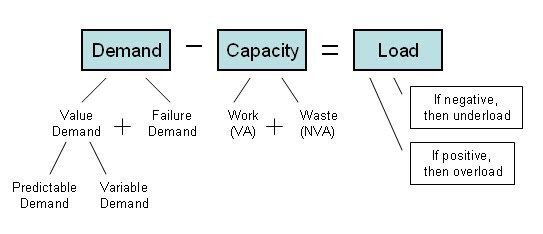
Demand is the amount of work in the system. Capacity is the resources available to do the work. Demand minus Capacity results in a Load on the system. If the demand is greater than the capacity the system is overloaded. If the demand is less than the capacity the system is considered underloaded.
John Seddon, author of Freedom from Command and Control
Taiichi Ohno, considered the father of the Toyota Production System, said that capacity is work plus waste. So if we identify and eliminate waste then “free” capacity is released into the system. Removing waste also allows for further reduction in failure demand.
Some underload is desirable because of variation in demand. A process that is loaded to 100% (where demand equals capacity) will frequently fail to meet the customer’s requirements. When the system is underloaded then any spare resources should be directed to waste removal.
Reducing variation in demand by persuading customers to take smaller, more frequent batches can reduce the load on the system. This can result in improved customer service levels and the ability to handle more demand.
This Lean equation illustrates that reducing failure demand, reducing wastes, leveling the demand, reducing variation, and using slack capacity to focus on improving efficiency are all necessary for satisfying the customer’s requirments. Furthermore, these activities result in feedback loops within your business system for continued input for PDCA (plan-do-check-act).









Leave a Comment
Your email address will not be published. Required fields are marked with *