 A Lean Journey
 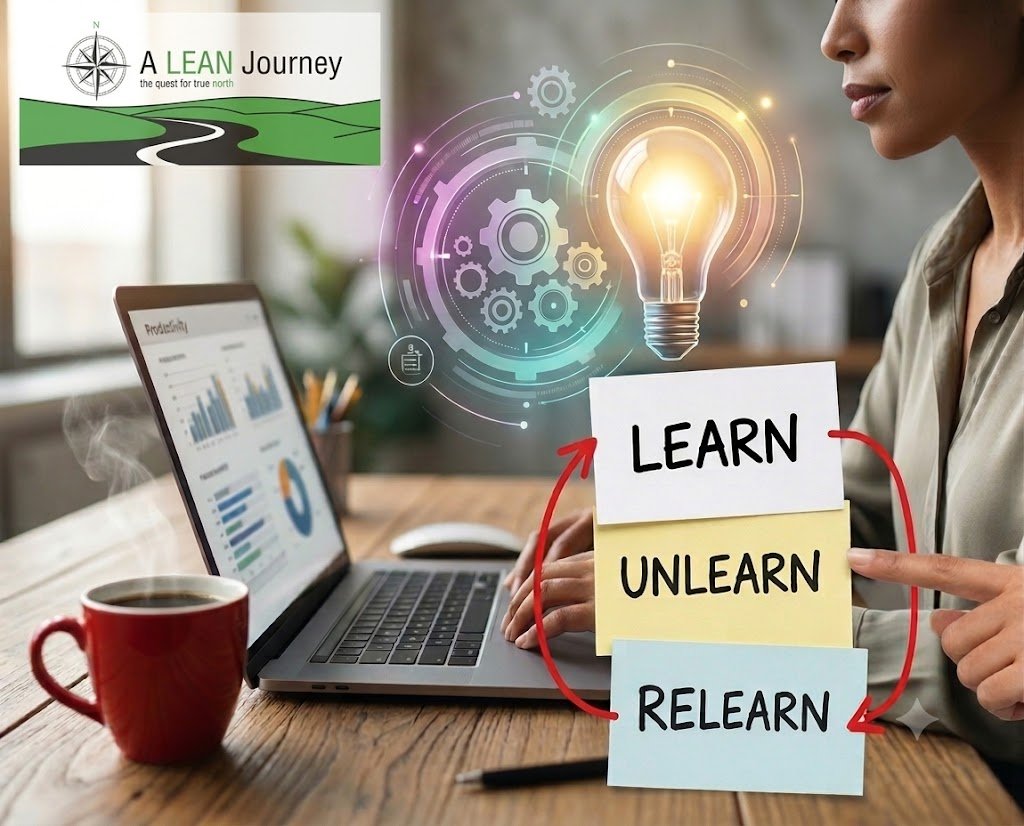 “The illiterate of the 21st century will not be those who cannot read and write, but those who cannot learn, unlearn, and relearn.”
This well-known quote from futurist Alvin Toffler captures one of the most important capabilities for individuals and organizations today. In a world defined by rapid technological change, shifting markets, and evolving customer expectations, knowledge alone is no longer enough. What matters most is our ability to continuously adapt what we know.
For leaders, this idea is especially powerful. Success today is not determined by how much knowledge you accumulate—but by how willing you are to challenge, update, and sometimes abandon what you previously believed to be true.
The Half-Life of Knowledge Is Shrinking
Not long ago, knowledge lasted a long time. Skills learned early in a career could remain relevant for decades. Today, that reality has changed dramatically.
Technologies evolve. Markets shift. New business models emerge. Artificial intelligence is transforming how work gets done. Processes that were best practice just a few years ago may already be outdated.
This means that the most dangerous phrase in any organization may be:
“That’s how we’ve always done it.”
When we cling too tightly to past success, we risk becoming prisoners of it. Continuous improvement—and true agility—requires the courage to question even the methods that once worked well.
Learning Is Only the First Step
Most organizations value learning. They invest in training, development programs, and knowledge sharing. But Toffler’s quote highlights something deeper.
Learning alone is not enough.
Sometimes the real challenge is unlearning—letting go of assumptions, habits, and mental models that no longer serve us.
Unlearning can be uncomfortable because it challenges our expertise. The more experienced we are, the harder it can be to admit that what worked before may no longer be the best approach.
Yet the organizations that improve the fastest are those that make questioning normal. They encourage people to test ideas, challenge assumptions, and experiment with better ways of working.
Why Unlearning Is Essential to Continuous Improvement
Lean thinking has always emphasized reflection and adaptation. Continuous improvement requires teams to constantly ask:
- What problem are we trying to solve?
- What assumptions are we making?
- What evidence tells us this process is the best way?
Standardized work provides a baseline for improvement—but it is never meant to be permanent. Standards represent the best known method today, not the best method forever.
When teams understand this, standards become a platform for learning rather than a barrier to innovation.
The cycle becomes simple:
- Learn the current best method.
- Unlearn outdated practices when evidence shows a better way.
- Relearn through experimentation, reflection, and improvement.
This cycle is the engine of continuous improvement.
Leadership in the Age of Adaptability
For leaders, the implications are significant. The traditional image of leadership as the “person with the answers” is becoming obsolete.
Instead, the most effective leaders today focus on creating environments where learning happens quickly and continuously.
They do this by:
- Encouraging curiosity rather than defending the status quo
- Rewarding experimentation and problem-solving
- Treating mistakes as learning opportunities
- Asking better questions instead of providing quick answers
When leaders demonstrate their own willingness to learn and adapt, it signals to the organization that change is not something to fear—it’s something to embrace.
Building a Culture of Relearning
Organizations that thrive in uncertainty tend to share several cultural characteristics.
First, they value humility over certainty. People recognize that no process, system, or idea is ever perfect.
Second, they make improvement visible. Problems are surfaced quickly so teams can learn from them.
Third, they practice reflection. Teams take time to ask what worked, what didn’t, and what should change next time.
This reflection is what turns experience into learning—and learning into capability.
The Competitive Advantage of Adaptability
In many industries today, the advantage no longer belongs to the biggest or most established organizations. It belongs to those that can learn faster than the rate of change around them.
Companies that continuously learn, unlearn, and relearn build resilience. They adjust more quickly to new technologies, customer needs, and market disruptions.
Individuals who do the same build careers that remain relevant regardless of how their industries evolve.
Final Thought
Reading and writing were once the defining skills of literacy. Today, the ability to adapt our thinking may be even more important.
The future will reward those who stay curious, question assumptions, and remain open to new ways of working.
Because in the end, the most powerful capability in the modern workplace is not knowledge itself—it is the willingness to continually rethink what we know.





Leave a Comment
Your email address will not be published. Required fields are marked with *