 A Lean Journey
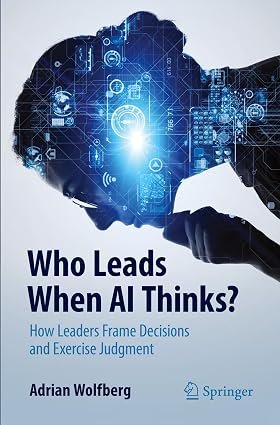
Artificial intelligence is rapidly becoming part of everyday business decision-making. From data analysis and forecasting to content creation and problem solving, leaders are increasingly being asked to determine how AI should fit into their organizations. While many books focus on the capabilities of AI, Adrian Wolfberg’s Who Leads When AI Thinks? takes a different approach. Rather than asking what AI can do, Wolfberg explores what leaders must do to ensure human judgment remains at the center of decision-making.
Overview
At its core, this is not a book about technology. It is a book about leadership.
Wolfberg argues that one of the most important responsibilities of leadership is framing problems correctly. While AI can help generate answers, analyze data, and identify patterns, it cannot determine whether an organization is asking the right questions in the first place. That responsibility remains firmly with people.
The book is built around three central questions:
- Who leads in the relationship between humans and AI?
- How should work flow between them?
- How should that relationship adapt as situations change?
Using the metaphor of a “dance” between human and artificial intelligence, Wolfberg provides a framework for determining when AI should lead, when humans should lead, and when collaboration between the two creates the best outcomes.
Key Themes
One of the book’s strongest messages is the warning against overreliance on AI. Wolfberg cites research suggesting that excessive dependence on AI-generated outputs can weaken critical thinking, creativity, and problem-solving abilities. Leaders must intentionally design processes that leverage AI’s strengths while continuing to develop human capabilities.
Another recurring theme is the importance of matching the tool to the problem. AI excels at processing information, identifying patterns, and supporting routine decisions. However, complex challenges that require judgment, adaptability, and creativity still demand strong human leadership. The author’s framework helps leaders determine when AI should automate, assist, augment, or simply inform decision-making.
Throughout the book, Wolfberg maintains a balanced perspective. He neither overstates the promise of AI nor dismisses its value. Instead, he presents AI as a powerful tool whose effectiveness depends largely on how leaders choose to apply it.
What Lean Practitioners Will Appreciate
Lean practitioners will likely find many familiar concepts throughout the book.
Lean has always emphasized understanding problems before implementing solutions. Whether through PDCA, A3 Thinking, or root cause analysis, effective improvement begins with careful observation and thoughtful problem definition. Wolfberg extends this principle into the age of AI by arguing that framing and reframing problems may become even more important as technology becomes more capable.
The book also reinforces the importance of developing people rather than relying solely on technology. Its central message—that AI should enhance human thinking, not replace it—aligns closely with Lean’s respect-for-people principle and the belief that sustainable improvement comes from strengthening problem-solving capabilities throughout the organization.
Strengths and Limitations
One of the book’s greatest strengths is its focus on leadership rather than technology. Wolfberg provides practical frameworks for thinking about decision-making, accountability, and judgment in an AI-enabled world. The examples are relevant across industries and help translate abstract concepts into real-world situations.
Readers seeking technical guidance on implementing AI systems may find the book less practical than expected. This is not a manual for deploying AI tools or understanding machine learning algorithms. The discussion is intentionally focused on leadership and organizational effectiveness. Some readers may also find the framework-heavy approach somewhat academic at times.
Final Thoughts
My biggest takeaway from Who Leads When AI Thinks? is that as AI becomes more powerful, leadership judgment becomes more important—not less.
Organizations that simply automate decisions risk losing the critical thinking and adaptability required to navigate complex challenges. The leaders who will be most successful in the future will be those who know how to combine the strengths of both human and artificial intelligence while maintaining ownership of the most important task of all: defining the problem.
I recommend this book for Lean leaders, continuous improvement practitioners, operational excellence professionals, and executives seeking to better understand the role of leadership in an increasingly AI-enabled world. Wolfberg offers a timely reminder that while technology may help us solve problems faster, it is still people who must ensure we are solving the right ones.
Disclaimer
A copy of this book was provided for the purpose of this review.




Leave a Comment
Your email address will not be published. Required fields are marked with *