 A Lean Journey
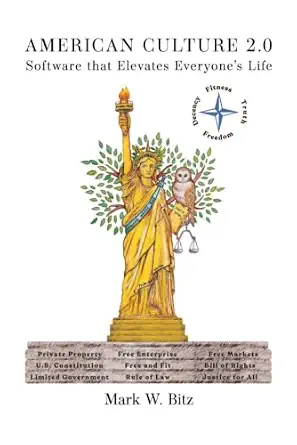
What if culture is the software that determines how well the human “hardware” of individuals, organizations, and societies performs? That is the intriguing premise behind Mark Bitz’s ambitious book, American Culture 2.0: Software that Elevates Everyone’s Life.
About the Book
Title: American Culture 2.0: Software that Elevates Everyone’s Life
Author: Mark Bitz
Publisher: Flourishbooks.org
Publication: 2026
Genre: Nonfiction / cultural analysis / social philosophy
The book is a substantial exploration of what Bitz believes contributes to human and societal flourishing. Published in 2026, it is structured around the idea that humans have biological “hardware,” while culture provides a learned operating system that influences how we think, behave, and interact.
Bitz develops this idea across seven levels of human organization: individual, family, groups, education, enterprise, government, and culture. He identifies approximately 300 “Winning Perspectives” and “Winning Practices” that he believes can contribute to positive outcomes for individuals and society.
At the center of the framework is what Bitz calls the Flourish Compass: Fitness, Truth, Freedom, and Decency. These concepts become the foundation for examining everything from personal habits and family life to education, business, and government.
A Lean Perspective
The part of American Culture 2.0 that I found particularly interesting was its emphasis on improvement. Bitz discusses experimentation, piloting ideas, evaluating results, and then rejecting, modifying, or implementing changes based on what is learned.
That mindset will sound familiar to anyone who has practiced Lean.
The book’s systems perspective is another strength. Rather than treating individual behavior as isolated from the surrounding environment, Bitz argues that outcomes are influenced by the larger systems in which people live and work. That connection between culture, behavior, systems, and results provides plenty of material for leaders to consider.
The book’s greatest strength is also one of its challenges: its scope. Bitz attempts to connect evolutionary science, psychology, economics, education, leadership, enterprise, government, and culture in a single framework. The result is intellectually ambitious, but at more than 600 pages, it can sometimes feel more like an extensive collection of perspectives and practices than a tightly focused argument.
Readers should also recognize that the later sections move beyond cultural analysis into specific positions on government and public policy. Those sections will likely generate different reactions among readers depending on their own perspectives.
Final Thoughts
American Culture 2.0 is not a quick read, nor is it a conventional business or leadership book. It is an ambitious attempt to examine how the “software” of culture influences the performance of individuals and the systems around them.
For leaders, educators, entrepreneurs, and continuous-improvement practitioners interested in the relationship between culture, behavior, systems, and results, the book offers plenty to consider.
Perhaps the most relevant takeaway for a Lean thinker is simple: if culture is the software, improving results requires paying attention to the system that shapes how people think and act.
Disclaimer
A copy of this book was provided for the purpose of this review.




Leave a Comment
Your email address will not be published. Required fields are marked with *