 A Lean Journey
Last week I
attended the Northeast Lean Conference in Worcester, MA. The Northeast Lean
Conference was created by GBMP to provide information and inspiration to Lean
practitioners – from those just starting out to seasoned Lean leaders from the
manufacturing, healthcare, service and other vital industry sectors.
The theme, It’s
About Time, has a double meaning:
- First, the
correct use of Lean methods – from 5S to SMED to Standardized Work – absolutely
reclaims and repurposes wasted time for the betterment of customers, employees,
and the company. Provide employees with
these methods and watch the creativity surge. - Second, there
has never been a better time than today when so many organizations regardless
of industry share a common motivation:
How to satisfy increased customer demand in the face of scarce
resources? Doesn’t that sound like
Lean? It’s about time for management to
make a visible commitment to continuous improvement.
Andrew Koenig,
CEO of City Furniture, kicked off the conference with message about Lean implementation
with heart. Andrew’s lean journey started in college with a trip to Toyota in
Japan. He implemented Lean throughout all departments in a retail company by
creating a culture of mutual trust and respect, teamwork, and a deep sense of
urgency to continuously improve. As a result, they have seen many major
breakthroughs in turnover reduction, operational process improvement, customer
experience, safety, associate satisfaction, strategic planning, and finance. We
need to focus on people and teamwork – not just problem solving. “You need to
have strong mutual respect among all the associates, so they feel no fear in
offering ideas and highlighting problems,” Andrew explained. “Every day, we are
pulling problems out of our associates, and leaders, working together to solve
them.” For strategic planning purposes, Andrew has a catchphrase: Bottom Up,
Top Down, Closed Loop. “We are trying to get everyone in the entire company to
participate in our strategic planning processes, give us their ideas, and share
that with the senior team, who then share that with me. What I learned from
Toyota is that you need to get everyone engaged in improving the
business.”
Melinda Mante,
GBMP Lean Consultant, showcased a set of practical habits you can immediately
implement to inspire action from her experience at Intel. There are 3 leadership
actions:
- Set direction –
challenge the status quo - Show the way – go
first, learn, and demonstrate - Support – enable,
encourage, and care
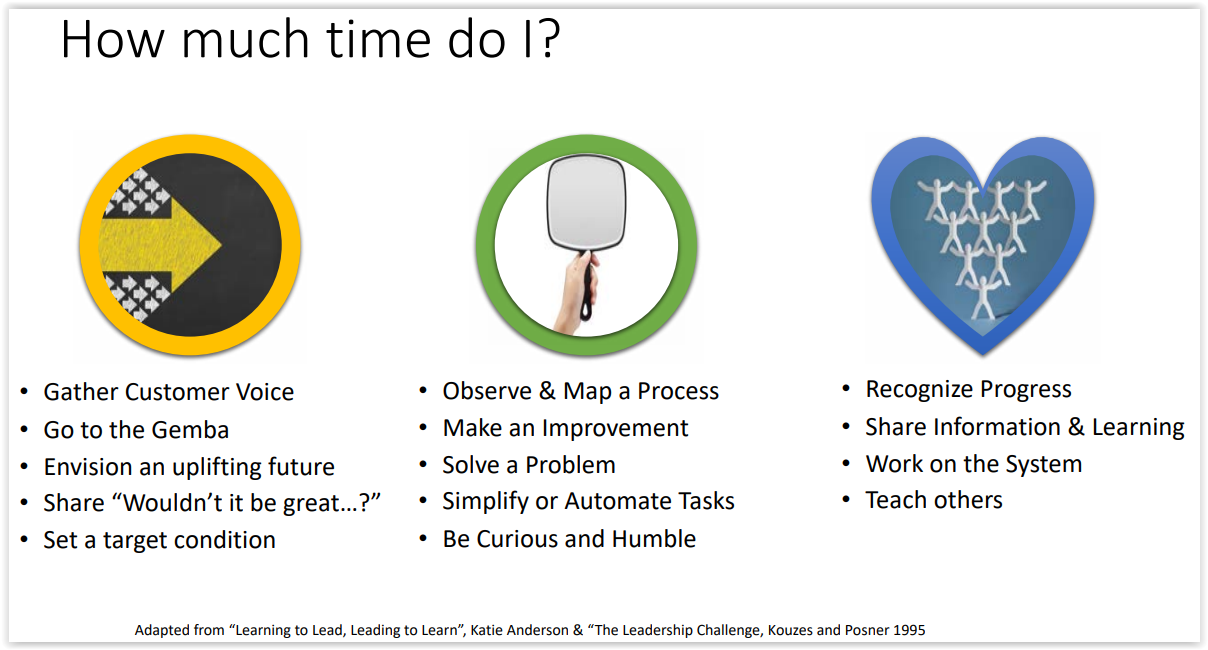
There is approximately
4000 weeks to live on average. Every day matters. At work its’ much less. Set
aside time on calendar for these leadership elements.
Tom Sullivan, Senior
Vice President of Operations at Ruger, ended the first day share their journey
to develop a Lean New Product Development process.
Highlights
included:
- Dedicated
formal project management is very important – Obeya Room co-located teams - Simultaneous
product & process development (Single Thought Flow) “Tatakidai” = chopping
block, rapid prototyping - Virtual Obeya
Room – COVID pushed this idea but still very effective for dispersed teams - Leaders Genba
with Lean NPD Team – Servant Leadership - Focus on Lean
Thinking – PDCA, 8 wastes for NPD, Mura, Muri - Standard Work –
the one best way to do something
Billy Taylor, Founder
and CEO of LinkedXL, got day 2 going by sharing three key principles:
Deliberate Clarity, Deliberate Ownership, and Deliberate Practice to achieve
success in any organization. Billy says “Winning is not everything, how you win
is everything.” Most people don’t know if they are winning and many leaders
only know at end of month. If you make people visible, hhey will make you
valuable.
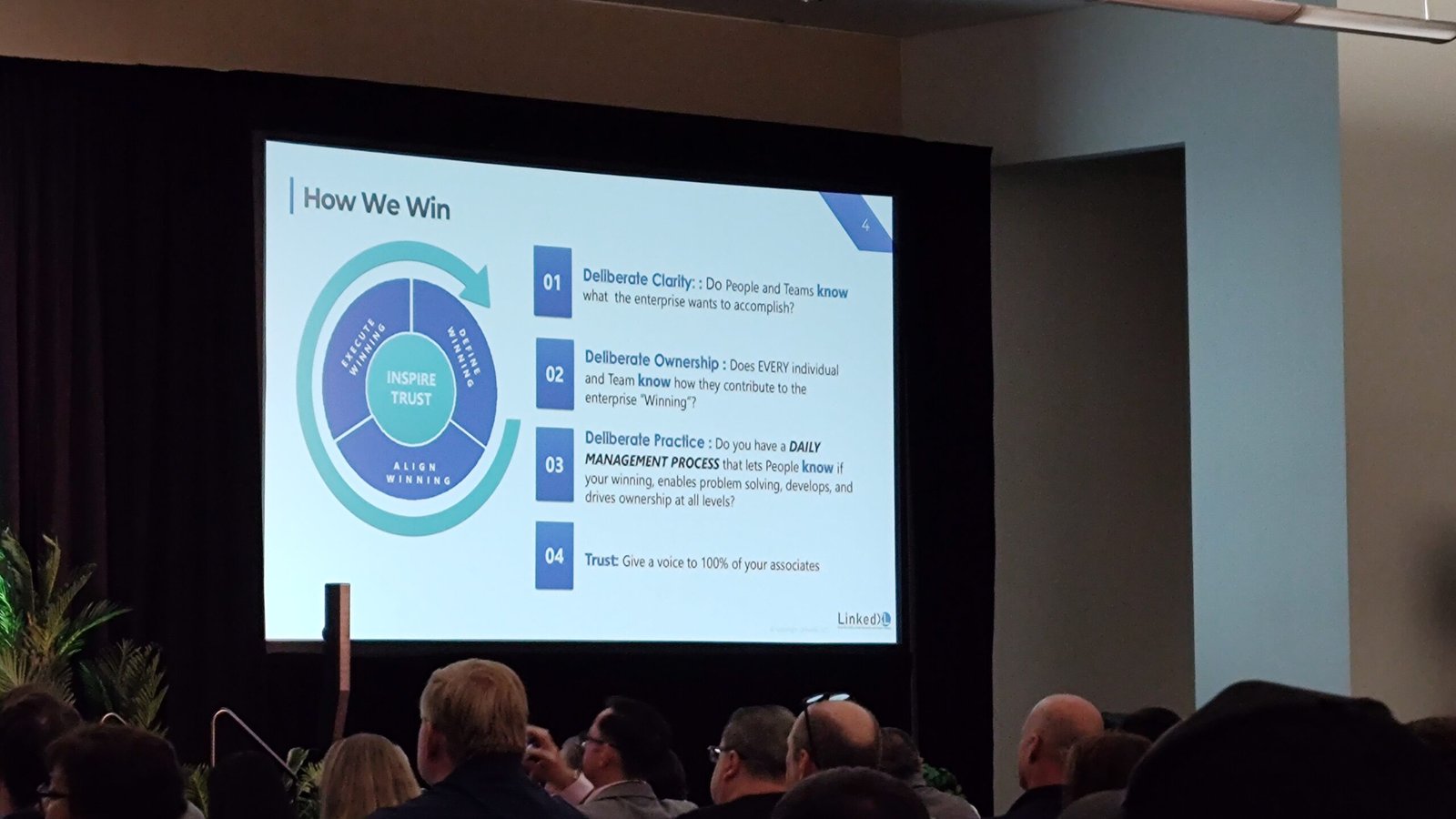
From his book “The Winning Link” Billy outlines how we win:
- Deliberate
Clarity – You can not manage a secret, Define Winning - 10ft and 10sec rule
– ask people close to board what the board means to them - What is your
leadership standard – What you tolerate, you cannot change - Walk by and not
say anything and then that is new standard - Deliberate
Ownership - Strategy +
Execution = Results - In the absence
of ownership comes blame - Celebrate the red
so you can harvest the green - Deliberate
Practice – Daily Management Process, Let’s people know if we are winning or
losing. - Enables problem
solving, drives ownership - Physical Safety
is needed - Take action
- Be hard on the
process so you can lead easy on the people - Trust
- Earning the
Right to Change - Create a safe
environment for change - Behaviors are
visible, Mindsets are hidden - Critical to
measure what matters…Everything that matters cannot be measured?
Allan Robinson,
Professor at UMass Isenberg School of Management, discussed strategies for managing
change. It is said that 70-80% of change initiatives fail because:
- Poor execution
of the chosen change methodology - Current methods
require time, effort, and patience - They require
extremely strong leadership
Most methods (from
the 1940s) don’t incorporate modern understanding in continuous improvement,
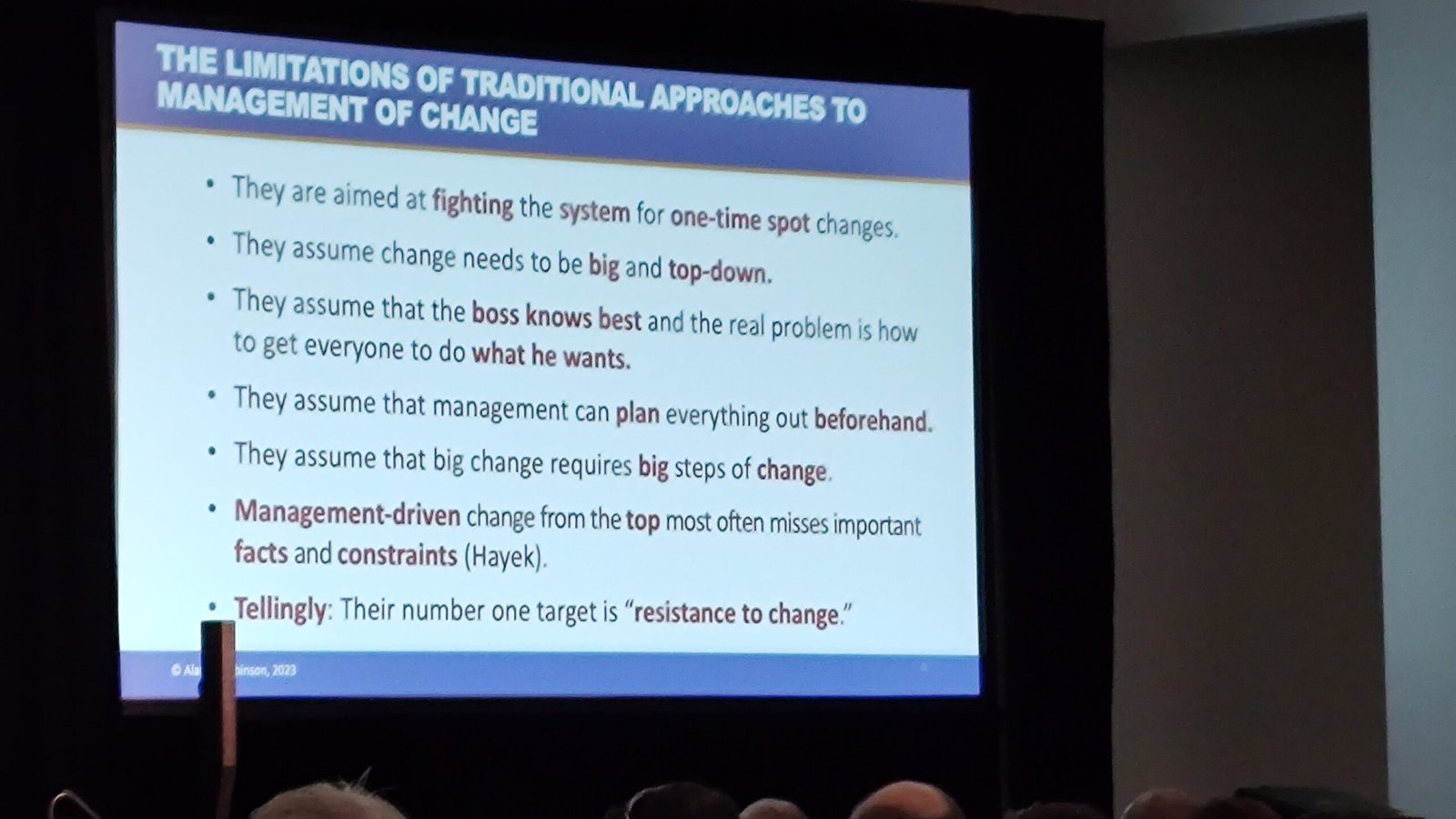
innovation, and lean. The limitations of traditional approaches to management
of change:
Perhaps our management
approach makes a difference: How can we make our organizations more adaptable
to change. A big part of the answer emerges from feedback loops and
dependencies discovered more recently by the lean, continuous improvement, and
innovation communities. Front-line driven important is a powerful way to make
your organization is more adaptable.
80% of
organization’s improvement potential is from front-line ideas
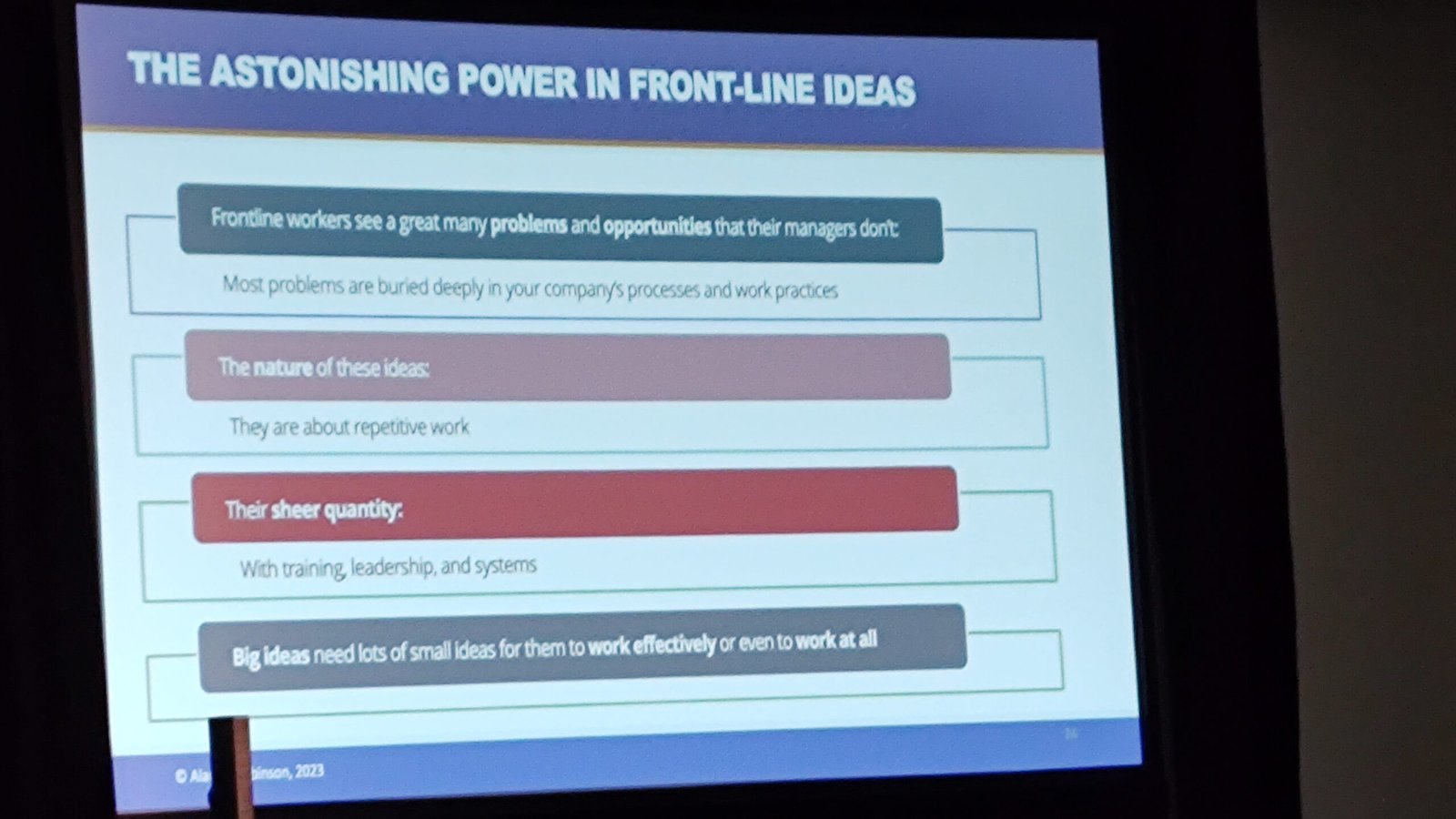
Frontline driven
improvement is very sensitive to poor leadership and misalignment, so it forces
managers and leaders to significantly change their behavior, and address
misalignments that are normally ignored. It cannot happen without also getting
high levels of trust and respect between management and the front lines. It
cultivates a culture of constant improvement and problem-solving.
Helen Zak, Director
of Research at The Shingo Institute, closed out the conference with tips, words
of wisdom, and learning from 38 years as a change agent. Helen’s Top 5:
- It’s All About
Time – the most valuable resource on the planet - Psychological
Safety – free from fear of acknowledging problems and comfortable tackling problems - Team Sport –
transformation requires alignment and teamwork - Dissatisfaction
with status quo – good enough is not enough - People
Development – lean leader’s job is to develop people
There were many
other great presentations, but this is a brief highlight. Mark your calendars
for next year’s conference Leveraging Lean to Thrive in Uncertain Times in Providence, RI November 7-8, 2024.







Leave a Comment
Your email address will not be published. Required fields are marked with *