 A Lean Journey
Process mapping is the foundation of operational clarity. Before you apply any Process Improvement Strategies, you need a clear, shared understanding of how work actually flows inside your organization.
When done right, Business Process Mapping Techniques create transparency, eliminate confusion, and unlock measurable efficiency gains. The goal isn’t documentation for the sake of documentation — it’s transformation.
Below is a structured guide presented in a tabular format to help you apply modern, practical, and results-driven mapping principles.
Core Process Mapping & Optimization Guide
| # | Focus Area | What It Means | Why It Matters | Practical Action |
| 1 | Define Scope Clearly | Identify start and stop points before mapping begins | Prevents overcomplication and wasted effort | Select high-impact processes that directly affect customers or revenue |
| 2 | Align Stakeholders | Ensure everyone understands the benefits and expected outcomes | Drives engagement and reduces resistance | Communicate value in terms of business outcomes |
| 3 | Train the Team | Standardize understanding of symbols, flow, and expectations | Improves accuracy and consistency | Conduct short workshops before starting |
| 4 | Prioritize Key Processes | Avoid mapping everything at once | Maximizes ROI of mapping effort | Focus on value-chain processes first |
| 5 | Document Current State | Capture the “as-is” before designing improvements | You can’t improve what you don’t understand | Avoid jumping directly to solutions |
| 6 | Conduct Process Walks | Observe real execution, not just documented SOPs | Reveals hidden waste and rework loops | Interview frontline employees |
| 7 | Capture Reality, Not Theory | Map shortcuts, workarounds, and rework | Ensures authenticity of the process map | Keep steps at the same detail level |
| 8 | Keep Tools Simple | Use visual, collaborative tools | Encourages team participation | Use sticky notes before digitizing |
| 9 | Include Process Data | Add cycle time, wait time, and variation | Identifies bottlenecks accurately | Include ranges, not just averages |
| 10 | Apply Visual Management | Use colors for lanes and pain points | Makes inefficiencies visible instantly | Validate flow before adding connectors |
Business Process Mapping Techniques That Drive Results
Modern Business Process Mapping Techniques go beyond basic flowcharts. They integrate data, collaboration, and continuous feedback loops.
Effective techniques include:
- Swimlane diagrams
- Value Stream Mapping
- SIPOC diagrams
- Cross-functional flowcharts
- Current-state vs future-state comparisons
These techniques ensure clarity across departments and build a shared operational language.
How to Create a Process Map (Step-by-Step Framework)
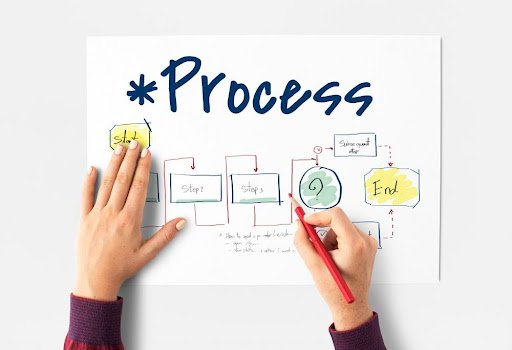
If you’re wondering how to create a Process Map, follow this structured workflow:
| Step | Action | Outcome |
| 1 | Identify the process | Clear focus area |
| 2 | Define scope | Boundaries set |
| 3 | Gather stakeholders | Cross-functional insight |
| 4 | Conduct process walk | Real data collection |
| 5 | Build current-state map | Visual baseline |
| 6 | Validate with the team | Accuracy confirmed |
| 7 | Add metrics | Data-driven clarity |
| 8 | Identify bottlenecks | Improvement opportunities |
| 9 | Design improved flow | Future-state optimization |
| 10 | Implement & monitor | Sustainable results |
This structured approach strengthens execution and reduces misalignment.
Lean Process Mapping Tools for High-Performance Teams
Applying Lean Process Mapping Tools ensures that waste becomes visible and measurable.
| Tool | Purpose | Benefit |
| Value Stream Mapping | Maps, material & information flow | Identifies lead time gaps |
| Swimlane Maps | Clarifies responsibility | Reduces handoff delays |
| SIPOC | Defines suppliers & outputs | Aligns process boundaries |
| Process Walk (Gemba) | Observes real workflow | Captures hidden inefficiencies |
| Visual Boards | Real-time tracking | Improves accountability |

Business Process Optimization Methods That Deliver Impact
Once your map is validated, the next step is applying Business Process Optimization Methods to drive measurable improvement.
| Optimization Focus | Strategy | Result |
| Eliminate Waste | Remove redundant steps | Reduced cycle time |
| Reduce Variation | Standardize workflows | Improved consistency |
| Improve Flow | Minimize handoffs | Faster delivery |
| Automate Repetitive Tasks | Use digital systems | Increased productivity |
| Strengthen Accountability | Clarify ownership | Better performance tracking |
Optimization is continuous. The process map becomes a living document — not a static file.
Why Process Mapping Fuels Continuous Improvement
When integrated into your operating rhythm, process mapping becomes the backbone of scalable growth. It aligns teams, exposes inefficiencies, and creates a structured pathway for innovation.
Organizations that combine:
- Clear mapping standards
- Data-driven analysis
- Lean Process Mapping Tools
- Strong stakeholder alignment
consistently outperform competitors in speed, quality, and cost efficiency.
Final Thought
Process mapping is not about drawing diagrams — it’s about building operational intelligence. When you apply the right Process Improvement Strategies and structured Business Process Optimization Methods, your business doesn’t just improve — it evolves.








Leave a Comment
Your email address will not be published. Required fields are marked with *