Floor Tape Store

Monday, May 13, 2024

Meet-up: 5 Questions from Within the Lean Community With Mark Graban

This month A Lean Journey Blog turns 15 and as I look back on how I got started and who influenced my journey I wanted to revisit a previous series I started in 2012 called the Meet-up.

One of the things I am so found of in the Lean community is the general wiliness to share with each other.  I have learned some much from my very experienced colleagues since I have been an active contributor.  Every month I roundup the best Lean related posts and articles I found particularly valuable from these fellow bloggers and contributors. Each one has their own story and opinions to share.

The goal of Meet-up is provide you an opportunity to meet some influential voices in the Lean community.  I will ask these authors a series of questions to learn about them, their lessons, and get their perspective on trends in industry.

In today’s edition we are going to Meet-up with Mark Graban. Mark has the longest running Lean blog that I know and sets a high standard to follow. I’ve been fortunate to meet Mark many times and collaborate on a few projects over the years that been fun and of course great learning opportunities for me. Mark put together a video of his response:

Here are his answers:

1. Who are you, what organization are you with, and what are your current  lean-oriented activities?

I’m Mark Graban, and I am fortunate to do a wide variety of things. I work independently through my own company, Constancy, Inc. — as a consultant (often partnering or sub-contracting with others), professional speaker, author, publisher, and podcaster.

I’ve written or co-authored two Shingo-Award-winning books: Lean Hospitals and Healthcare Kaizen. I’ve also edited and published the anthology Practicing Lean. And I’ve also written and published Measures of Success and my latest, The Mistakes That Make Us.

I’ve hosted and produced podcasts, including “My Favorite Mistake” and “Lean Blog Interviews.” The latter started in 2006 as an offshoot of my blog, LeanBlog.org

My career started in manufacturing, and that was my focus for the first ten years. However, I had the opportunity to start applying Lean in hospitals and healthcare settings back in 2005. That’s still my primary focus, but I enjoy helping people in other industries.

I am also currently a Senior Advisor to KaiNexus, a software company whose mission is to spread continuous improvement through its enterprise platform.  

2. How, when, and why did you get introduced to lean and what fueled and fuels the passion?

During my undergraduate Industrial Engineering studies at Northwestern University, I received an academic introduction to the Toyota Production System. What they taught was technically correct, but the topics were limited to technical topics related to inventory management and production planning—focused on flow and pull. 

After growing up near Detroit, I was skeptical about joining the automotive industry. But, I had the opportunity to take an I.E. job at my hometown General Motors Livonia Engine Plant. What was the appeal?  The plant claimed to work under a version of the “Deming Philosophy,” but as I’ve written about, it seemed that the philosophy died at the plant about the same time Dr. Deming passed away in 1993. I joined in 1995. It very well could have been 1975 in terms of attitudes and management style, but at least we had computers on our desks. 

The first year there was incredibly frustrating. The only thing keeping me going was an internal “Lean Team,” if you will, who had all been hired from Toyota suppliers or Nissan. The problem was our plant managers were still old-guard “command-and-control” GM people. They yelled, screamed, and blamed the workers for everything. It was an incredibly stressful place to work — and it felt like we were playing for a last-place team with no hope.

I was able and willing to learn from the Lean Team, even if the plant manager wanted nothing to do with them. The Lean Team people mentored me. And there was no shortage of waste or problems to see—and to talk through how their old employers would have done things and what could be possible there. 

Thankfully, after a year, a new plant manager was brought in to save us. He was one of the original “NUMMI Commandos” — a GM leader who was sent to learn from Toyota through the opening and the first few years of operating the joint venture plant in California. He was such a breath of fresh air. He literally told an all-hands meeting that the era of blaming the workers was over and that we’d succeed together, with the same workers being managed in a new and different way.

Over that first year, I saw the impact of the Lean management style. It wasn’t just a matter of now being unleashed to implement Lean tools and methods. It was the leadership mindsets that made such a difference. The new plant manager spent so much more time out on the shopfloor—listening, building relationships, and building the employee’s confidence in him.

Within a few years, the plant almost duplicated aspects of the NUMMI turnaround story. They went from being quite literally the worst in GM plant performance (in productivity and quality measures) to being in the top quartile.

This inspired me to try to help bring this sort of turnaround to others. Sadly, the conditions of that painful first year still exist in some locations today — including in healthcare. 

3. In your opinion what is the most powerful aspect of lean?

The most powerful aspect of Lean is that it’s an integrated system. As Toyota explains, even today, the Toyota Production System is not just tools and technical methods. It’s also a philosophy and a set of managerial practices. It’s an organizational culture that puts a huge focus on developing people. Since the term “Lean production” was meant to be a genericized term for TPS, successful Lean journeys are led by leaders who realize it’s an integrated system. 

One of the most powerful components is when Lean leaders tap into the intrinsic motivation of employees to improve. These leaders aim to engage everybody, enabling them to implement improvements that matter to them. These leaders also help steer improvements, especially larger projects, toward the “true north” goals of Safety, Quality, Delivery, and Cost.

4. In your opinion what is the most misunderstood or unrecognized aspect of lean?

One misunderstood aspect is the idea that implementing a few Lean tools here and there will make a transformational difference. A similar trap is thinking that a series of week-long Kaizen Events will automatically create a culture of ongoing daily continuous improvement. If the events are only engaging a handful of the employees, that’s nowhere near the Kaizen ideal of everybody improving everywhere, everyday. A related pitfall to that is thinking that certifying a large number of people as some sort of “belt” will lead to significant culture change. Leaders must lead the Lean transformation, participating in it and not just sponsoring or supporting it.

I think the most unrecognized aspect of Lean is its foundational role of “psychological safety.” Psychological safety is the feeling or perception that a person can speak up candidly without fear of being punished or marginalized in some way. This includes speaking up about mistakes, problems, and improvement ideas.

When Toyota describes its system and culture, I think many of the writers take it for granted that you can speak up (or pull an “andon cord”) without fear of punishment. Toyota team members should expect a helpful and constructive response when they speak up. When organizations try copying tools and methods from successful Lean organizations, such as Kaizen boards or andon-type systems, if that organization has a low level of psychological safety, Lean won’t ever take hold. 

Many organizations invest greatly in problem-solving training. But if employees don’t feel safe to point out or admit problems, what is going to be solved? Nothing, or not much.

A final misunderstanding related to employee participation in Lean is that it can be forced or incentivized. Getting compliance, such as “I did my four improvements this year,” isn’t the path to world-class performance. Instead of lecturing people about their duty to speak up, demonstrate that it’s actually safe and effective to do so.

5. In your opinion what is the biggest opportunity for lean in today's world? How can that be accomplished?

I still think the greatest opportunity is in healthcare. It’s been over 25 years since the first “Lean healthcare” experiments took place in the U.S. The problems in healthcare are real and significant. Estimates suggest one in four hospitalized patients suffer from a medical error and between 100,000 and 400,000 Americans are killed by medical errors each year—and we rely on estimates because real numbers are not tracked and shared by the healthcare industry. And this is a global problem, with other countries seeing similar per-capita levels of harm and death.

There are huge opportunities to use Lean methodologies to improve safety and quality, reduce waiting times, and improve the quality of care. Where this has been done, engaging employees and medical staff helps achieve those goals, while also improving employee satisfaction and reducing turnover.

There have been pockets of great progress in some health systems. But some of those systems have taken steps back from Lean when new leaders were installed from the outside. Too many still see Lean as tools to train frontline staff on—instead of seeing Lean as a management system and a culture of PDSA-based continuous improvement.

I think healthcare is repeating the waves of adoption, decline, and re-adoption that we’ve seen in manufacturing—first using some tools, then a broader set of tools, then followed by attempts to adopt a management system at wall levels. It’s frustrating when healthcare doesn’t learn from manufacturing on this and other fronts. So, we’ll keep working at it.


Through their answers to these questions hopefully you will get a sense of the thinking behind those who are shaping the Lean landscape.  I continue to keep learning and thankfully with the willingness of these practitioners to share I am positive you will, too.


Subscribe to my feed Subscribe via Email LinkedIn Group Facebook Page @TimALeanJourney YouTube Channel SlideShare

Friday, May 10, 2024

Lean Quote: Live For the Moment, It’s Happening Now

On Fridays I will post a Lean related Quote. Throughout our lifetimes many people touch our lives and leave us with words of wisdom. These can both be a source of new learning and also a point to pause and reflect upon lessons we have learned. Within Lean active learning is an important aspect on this journey because without learning we can not improve.


"May, more than any other month of the year, wants us to feel most alive.  —  Fennel Hudson

When’s the last time you felt exhilarated, lighthearted, and free? Or the last time you were fully present? When’s the last time you felt alive? 

Playfulness, connection, and flow are all energizing, happiness-boosting states when they occur on their own. But when we experience these three states at once—in other words, when we experience True Fun—the effects can feel magical. 

When we have True Fun, we are not lonely. We are not stressed. We are not consumed by self-doubt or malaise. Instead, we are focused and present, free from anxiety and self-criticism. We laugh and feel connected, both to other people and to our authentic selves. When people talk about past experiences in which they truly had fun, their faces light up because True Fun makes us feel alive. Prioritize fun, and you will feel yourself coming back to life. 

If our goal is a meaningful and joyful existence, both in the long term and in the day-to-day, understanding the importance of our attention is only the first step. Next we must decide, what do we want to pay attention to? 

Our natural tendency is always going to be to pay attention to the negative, to scan the horizon for potential attacks. It’s a survival strategy that serves us well when our dangers are physical and real. It also affects our experience of life—we pay far more attention to correcting what’s wrong than enjoying and nurturing what is going right. 

We all want lives that are filled with meaning, happiness, satisfaction, and joy—but we don’t know how to get there. These are nebulous destinations with no clear path, so instead, we spend our time chasing, striving, and competing, dwelling on the past as we sprint toward future goals, like drivers who are so focused on the road ahead that the scenery rushes by in a blur. 

But we are not problems that need to be fixed. We are lives that want to be lived. Living does not suddenly start when we achieve inbox zero, or win an argument on social media, or earn a promotion. It happens in every moment—it is happening right now. 

Wednesday, May 8, 2024

Meet-up: 5 Questions From Within the Lean Community with Jeff Hajek

This month A Lean Journey Blog turns 15 and as I look back on how I got started and who influenced my journey I wanted to revisit a previous series I started in 2012 called the Meet-up.

One of the things I am so found of in the Lean community is the general wiliness to share with each other.  I have learned some much from my very experienced colleagues since I have been an active contributor.  Every month I roundup the best Lean related posts and articles I found particularly valuable from these fellow bloggers and contributors. Each one has their own story and opinions to share.

The goal of Meet-up is provide you an opportunity to meet some influential voices in the Lean community.  I will ask these authors a series of questions to learn about them, their lessons, and get their perspective on trends in industry.

In today's edition, we are going to meet-up with Jeff Hajek. When I first started Jeff was a great resource and support for me as he was starting his own business. We shared a passion for Lean and sharing knowledge with others that led to many collaborative projects together. Jeff filmed a short video to answer these questions:

1. Who are you, what organization are you with, and what are your current lean-oriented activities?

2. How, when, and why did you get introduced to lean and what fueled and fuels the passion?

3. In your opinion what is the most powerful aspect of lean?

4. In your opinion what is the most misunderstood or unrecognized aspect of lean?

5. In your opinion what is the biggest opportunity for lean in today's world? How can that be accomplished?


Through their answers to these questions hopefully you will get a sense of the thinking behind those who are shaping the Lean landscape.  I continue to keep learning and thankfully with the willingness of these practitioners to share I am positive you will, too.


Subscribe to my feed Subscribe via Email LinkedIn Group Facebook Page @TimALeanJourney YouTube Channel SlideShare

Monday, May 6, 2024

Meet-up: 5 Questions from Within the Lean Community With Kevin Meyer

This month A Lean Journey Blog turns 15 and as I look back on how I got started and who influenced my journey I wanted to revisit a previous series I started in 2012 called the Meet-up.

One of the things I am so found of in the Lean community is the general wiliness to share with each other.  I have learned some much from my very experienced colleagues since I have been an active contributor.  Every month I roundup the best Lean related posts and articles I found particularly valuable from these fellow bloggers and contributors. Each one has their own story and opinions to share.

 The goal of Meet-up is provide you an opportunity to meet some influential voices in the Lean community.  I will ask these authors a series of questions to learn about them, their lessons, and get their perspective on trends in industry.


Today, we are going to get this kicked off with one of my original influencers and the person behind the idea for the Meet-up from his own blog back in 2010, Kevin Meyer. Here are his answers:


 1. Who are you, what organization are you with, and what are your current lean-oriented activities?

My name is Kevin Meyer, and I retired on January 1st, 2024 after 14 years as co-founder and CFO of Gemba Academy.  I continue to stay involved with the company on various strategic projects.  Prior to Gemba Academy I worked in various engineering, operations, and executive positions at primarily medical device manufacturers, ending with being president of a mid-market medical device company for eight years.  I am currently a member of a couple angel investment groups where in addition to investment I mentor and advise startups on the opportunity of leveraging lean methods.

2. How, when, and why did you get introduced to lean and what fueled and fuels the passion?

Back around 1997 I was working for Abbott Laboratories and transferred to their Salt Lake City facility to be operations manager of their largest molding operation, producing parts critical for other factories around the world.  The operation was 24/7/365, running at 100% capacity, but was nearly 3 months behind schedule, creating crazy visibility and “help” from corporate. 

While researching how to address the capacity issues while waiting for new presses to arrive in 3-6 months, I came across AME.  Doc Hall, Dave Hogg, and Dan McDonnell from AME taught me about quick changeover, and by the time the new presses arrived we had caught up and even had extra capacity.  I was sold and became a lean evangelist from that point on.  We used it to quickly quintuple production at a subsequent facility I became responsible for, and in my last position we reduced our costs so much that we could out-compete so-called “low cost” Asian competitors from the so-called “high cost” state of California.  Along with Ron Pereira and Jon Miller, we started Gemba Academy to give back and help train others on the concepts that had made us so successful.

 3. In your opinion what is the most powerful aspect of lean?

Respect for people, hands down.  Recognizing that traditional financial reports place a value on the “cost” of the pair of hands that is assembling product (or support activities), but there is no offset for the “value” of the brains that hold the creativity, experience, and collaborative multiplier - unlike with capital equipment - therefore poor and damaging decisions are made to chase “low cost labor.”  Find ways to tap into the power of those brains, while providing financial and psychological safety to encourage the risk that creates learning, even from failure.

 4. In your opinion what is the most misunderstood or unrecognized aspect of lean?

That lean is only for manufacturers.  An interesting data point is that over the past 14 years, subscribers to Gemba Academy’s training material changed from being predominantly manufacturers to being predominantly non-manufacturers.  There has been strong interest, and great results, in healthcare, government, services, and even education.

 5. In your opinion what is the biggest opportunity for lean in today's world? How can that be accomplished?

Lean principles and methods can be applied anywhere, even outside of work.  However, many of them (such as the power of one piece flow) are counterintuitive and need to be demonstrated to be believed.  We need more people experienced with lean to help spread the good news into more and different industries and situations.  There are many lean consultants and many lean training companies, but value is really demonstrated when the concepts are successfully implemented and returns are experienced.  This takes passionate, inquisitive, and creative people driving lean change - both from the top in executive positions but also from within organizations.  Lean is being taught in some universities - such as what Eric Olsen is doing at CalPoly, but a deeper understanding of lean should be taught as part of core curriculums.

 Through their answers to these questions hopefully you will get a sense of the thinking behind those who are shaping the Lean landscape.  I continue to keep learning and thankfully with the willingness of these practitioners to share I am positive you will, too.


Subscribe to my feed Subscribe via Email LinkedIn Group Facebook Page @TimALeanJourney YouTube Channel SlideShare

Friday, May 3, 2024

Lean Quote: All Things Seem Possible in May

On Fridays I will post a Lean related Quote. Throughout our lifetimes many people touch our lives and leave us with words of wisdom. These can both be a source of new learning and also a point to pause and reflect upon lessons we have learned. Within Lean active learning is an important aspect on this journey because without learning we can not improve.


"The world's favorite season is the spring. All things seem possible in May.  —  Edwin Way Teale

Impossible is a state of mind; what is impossible today may not be so tomorrow. What is impossible for us may not be so for others. This means that nothing is impossible if we know how to do it. To think otherwise will prevent us from finding a solution. Take flying for example. In the past, man could not fly. To make such a suggestion then would have made a person look stupid. But because some people refused to believe that flying was impossible, it is possible today. In fact, flying is so common that we take it for granted. The impossible has become the possible. When new changes or ideas become the accepted norms for us, we have greater options at our disposal. Today, we can travel by land, sea or air. In the future, space travel might become common for the masses.

It's easier to say something is impossible, or at least extremely unlikely. Everyone has periods of doubts. Everyone considers giving up sometimes, but then you just have to remember why you tried so hard in the first place.

Nothing is impossible. If you never tried it then you would never know if it worked. Every failure teaches you something if you are willing to learn from your mistakes. Those saying it cannot be done should not interrupt those trying it. Artificial roadblocks are wasteful and counterproductive. Keep trying. Keep learning.

Your self-belief as a leader is infectious as well. What do you believe about yourself? What do you believe about your ability? What is possible and what is impossible? Your willingness to try the impossible will inspire your team to push the limits as well.

Wednesday, May 1, 2024

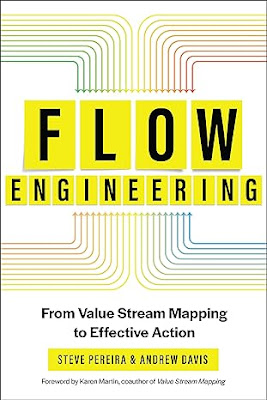
Book Review: Flow Engineering


Have you worked for or do you work for an organization that is growing exponentially. Our organizations are growing dramatically as it has become easier to expand operations globally either through acquisition or through addressing new markets. These fragmented segments and disconnected infrastructures can greatly impact radical transformation and business improvements. As the company grows waste and delay grow exponentially taxing the business more and more.

If you’re looking for a way to be able to chip away at this complexity turn to Flow Engineering: From Value Stream Mapping to Effective Action. Written by Value Stream Mapping experts Steve Pereira and Andrew Davis, Flow Engineering provides a step-by-step guide for running fast-paced mapping workshops that rapidly build shared understanding. Based on foundations from Value Stream Mapping, cybernetics, and the Toyota Production System, Flow Engineering's lightweight and iterative practices build the value, clarity, and flow required for effective collaboration and collective action.

Flow Engineering is a series of collaborative mapping exercises designed to connect the dots between an unclear current state and a clear path to a target state. It’s an open, adaptive, and engaging series of practices that can take you from complexity to clarity, from friction to flow.

Using the five key maps to facilitate collaborative “flow conversations,” Pereira and Davis show how teams can surface tangled process dependencies, conflicting priorities, and unspoken assumptions that grind progress to a halt. The result? A clear roadmap owned by the people doing the work to accelerate innovation cycles, optimize workflows, and achieve more effective coordination.

The book is organized into 3 parts. The first being gaps that need to be bridged and why they have been a challenge for most organizations. The second part lays the foundation for flow engineering with the five mapping steps. The last part describes approaches to scaling and sustaining your progress with Flow Engineering beyond an initial pilot. Throughout the book the authors use a fictional example to help illustrate the practices of Flow Engineering. Each chapter summarizes key learning points for emphasis.

This book is for Lean practitioners familiar with the basics of value stream mapping and basic agile knowledge. Curious problem-solvers struggling to help their teams or organizations see the big picture will find benefit from the techniques in Flow Engineering. It’s easy to adapt and tailor to varied situations. It’s flexible enough to help teams of any skill level, and it’s robust enough to be used for ambitious process improvements or day-to-day problem-solving.

If you are looking to improve flow, explore more, or be inspired then consider reading Flow Engineering.

This book will be released May 14th but you can preorder here: https://amzn.to/3QkTZhc


Note: The publisher IT Revolution sent me an advanced copy to review.


Subscribe to my feed Subscribe via Email LinkedIn Group Facebook Page @TimALeanJourney YouTube Channel SlideShare

Monday, April 29, 2024

Lean Roundup #179 – April 2024


A selection of highlighted blog posts from Lean bloggers from the month of April 2024.  You can also view the previous monthly Lean Roundups here.  


Strategy Digi-deployment – Bruce Hamilton shares a few potential (and common) pitfalls to avoid when digitizing your strategic deployment plan.


Simplifying Lean – Bob Emiliani discusses the problems from simplifying Lean in terms of method and in terms of objective.


Enhancing Organizational Efficiency through Supplier Process Improvement – John Knotts explains why working with suppliers to improve their processes is a strategic necessity in today’s complex and competitive business environment.


My Piece for IndustryWeek: Boeing Executives Failed to Lead, Waved Off Lean – Mark Graban discusses the Boeing failures being a company problem, not a worker problem.


Content Follows Form or Acting Your Way to New Thinking – Pascal Dennis explains Lean excellence rests on a set of mental models or mindsets and through these routines you can change one’s behavior.


Nine Tips to Better Process Development - Eric Ethington and Matt Zayko share nine proven techniques for designing successful, waste-free processes to achieve exceptional results with your next product launch.


Continuous Improvement vs Operational Excellence | KaiNexus - JJ Puentes explains the difference between these two complementary paradigms that guide business operations management so that you can apply elements of both to streamline operations and achieve your most critical strategic goals.


Lean Transformation for Enhanced ROI - Matt Banna shares some tools that help optimize lean transformation depending on your organization's objectives.


How Top Organizations Approach Enterprise Digital Transformation - Danielle Yoon explains how organizations are embracing digital technologies and modernizing processes to enhance operational efficiency, improve agility, and unlock new opportunities for growth and innovation.


How Status Regulates Progress – Bob Emiliani says to improve the understanding and practice of management one must go into this work with eyes wide open and have an interest in learning from the difficulties and mistakes of others that preceded them.


More Crisis Control at Boeing and the FAA – Some Lessons on Building in Quality from NUMMI – John Shook explores how the NUMMI joint venture between Toyota and GM offers vital lessons on integrating quality right from the start as Boeing grapples with recurring quality issues.


Digital Transformation in Manufacturing: Benefits, Key Challenges, and Solutions – Megan Cox explores the ongoing digital transformation in manufacturing and the challenges, benefits, and best practices for aligning smart manufacturing technologies with business goals and values.


Subscribe to my feed Subscribe via Email LinkedIn Group Facebook Page @TimALeanJourney YouTube Channel SlideShare