Floor Tape Store

Friday, October 7, 2022

Lean Quote: Great Leaders Encourage Problem Solving

On Fridays I will post a Lean related Quote. Throughout our lifetimes many people touch our lives and leave us with words of wisdom. These can both be a source of new learning and also a point to pause and reflect upon lessons we have learned. Within Lean active learning is an important aspect on this journey because without learning we can not improve.


"Build a culture that rewards—not punishes—people for getting problems into the open where they can be solved.  —  Ben Horowitz, co-founder, VC firm Andreessen Horowitz

When employees collectively work toward solving problems, it builds a team environment, encourages collaborative effort and prompts staffers to have a vested interest in making your company stronger. Problem solving can also create stronger bonds between colleagues and improve the overall workplace dynamic.

Encourage problem-solving by forming employee committees, think tanks and representative groups that contribute departmental feedback to the upper echelons of management. This type of approach helps employees see their input and opinion is valued, respected and sought after. Not only will staffers start taking a more significant interest in problem solving and making the company successful, management will also benefit from getting feedback from frontline employees.

Don't be tied down by stagnant processes or ways of thinking. Promote a philosophy of being open to change and suggestions from employees. Host brainstorming sessions and encourage staffers to voice their opinions and bring new ideas to the table without fear or judgment. Institute a system where employees from all levels can bring new concepts to management, and reward forward-thinking initiatives.

Great managers appreciate the different perspectives their team members bring to the table and create balanced workspaces. They set the expectation that everyone on the team helps one another, values one another, and will work together to accomplish team goals.

Employees need the freedom and authority to solve problems that relate to their work. Encourage increased levels of problem-solving among employees by providing training on problem-solving best practices in your industry. Today’s workers want training that helps them advance their knowledge and career.

When your employees feel confident in their ability to solve problems, as well as their manager’s confidence in them to ask questions and solve problems, the organization and the individual benefits, and you, as their manager, have more time to work on what you want to get done.

Subscribe to my feed Subscribe via Email LinkedIn Group Facebook Page @TimALeanJourney YouTube Channel SlideShare

Wednesday, October 5, 2022

How To Ensure Open Communication In The Workplace?

Source: https://pixabay.com/illustrations/man-business-people-woman-business-162951/


Effective communication in the workplace is the key to the company’s success. The problem is that working together and ensuring that everyone is on the same page may be challenging. Discover some helpful tips to encourage open communication in your workplace.

You have probably heard that communication is the key to a successful relationship, and the same is true for work relationships. When open communication is lacking, misunderstandings occur, and trust is lost.

It is critical to have effective communication in the workplace to build trusting relationships, foster creativity, and increase productivity. Let’s look at five effective strategies for improving open communication in the workplace.

The Top 5 Strategies to Improve Open Communication in the Workplace

According to statistics, approximately 86% of employees and executives report a lack of effective communication at work, which leads to poor performance and failure. Here are some things you can do to promote open communication among your employees and improve results:

1. Talk It Out

If you have a problem, you bottle it up, and eventually, it all comes out in a messy explosion. That is why you should have an open line of communication in the workplace. If you do not talk about your problems, they are going to fester and get worse.

The first step is to make sure that you and your coworkers understand the goals, methods, and required tasks. It means having regular meetings to discuss updates, goals, and any issues that might be brewing. It also helps to be proactive about communication.

If you see a problem starting to develop, address it before it becomes a bigger issue. Another key to effective communication is listening. Make sure you are giving your coworkers your undivided attention, and do not jump to conclusions or interrupt them. And lastly, be respectful of everyone’s time. If someone does not want to talk about something, let them off the hook.

2. Listen Up

Listening is an essential part of open communication. When you listen to someone, it demonstrates that you are paying attention and are interested in what they are saying. It is also a great way to connect on a personal level with your coworkers. Take the time to listen to what someone is saying the next time they share something with you.

Check your understanding of what you have heard, and ask questions if necessary. And keep in mind that because you are paying attention, it does not mean you have to agree with everything they say. As long as everyone is respectful of each other, healthy debate is part of open communication.

3. Get Everyone on the Same Page

When it comes to workplace communication, you should ensure that everyone is on the same page. This way, you will avoid misunderstandings and wastage of time. You may wonder, “How can you accomplish getting everyone on the same page?” The answer is easy – by establishing a communication strategy.

This document should outline the dos and don'ts of workplace communication and be something that everyone is familiar with. Regular team meetings are another way to get everyone to look in the same direction. It is a great way to keep everyone up to date on what is going on while also providing an opportunity to brainstorm and come up with new ideas.

If writing organizational documents is not your strong suit, or if you are unsure whether they are as precise and clear as possible, you should consult a professional or visit online writing review services to help you overcome the problem.

4. Set Some Ground Rules

Before you start communicating with your team, you should develop a list of the ground rules. This way, everyone will know what is expected of them and there will be less room for misunderstanding. Some things you might want to consider include:

·        How frequently are team members expected to check in?

·        What are the best ways to communicate (email, chat, phone, or in person)?

·        When is it okay to interrupt someone?

·        How much detail is needed in messages?

You can create a friendly environment where communication is less stressful and more efficient by establishing some ground rules ahead of time. Writing rules can be challenging at times. Furthermore, your policies should not violate employees’ personal freedoms or rights.

5. Keep It Positive

Even if you are the head manager or the leader of a company, you should not be harsh with your employees. To foster trust, you should positively treat your teams so that they are not afraid to tell you about workplace difficulties or problems. One of the most important strategies for improving office communication is to keep things positive.

Negative things are known to increase tension and division. That is why you must stay away from them. Focusing on the positive brings the team together and makes them feel more connected, creative, and productive. Celebrate your victories and look for the good in each other.

Conclusion

Open communication is the cornerstone of a productive workforce, and by “open,” one means clear communication between everyone from the employer to the employee. An open workplace leads to a more positive, friendly environment where everyone can be free to speak their mind, ask for help when needed, and express any concerns about work. If there is no open line of communication in the place where you work, your business will never reach its full potential, and sooner or later, it may crash and burn.


About the Author: Nancy P. Howard has been working as a writing expert at Trust My Paper writing company for a year. She is also a webmaster at best essay writing service. She loves travelling, photography and is always welcome to meet new people.


Subscribe to my feed Subscribe via Email LinkedIn Group Facebook Page @TimALeanJourney YouTube Channel SlideShare

Monday, October 3, 2022

Northeast Lean Conference 2022 Re-cap


This past week I was fortunate to be able to attend one of my favorite annual activities, the Northeast Lean Conference. The theme of the conference this year was centered around amplifying lean, the collaborative effect. I presented with a colleague on collaboration within new product development at the conference. I’ll get to that in a moment but for now I want to take the opportunity to share some insights from my experience at the conference that we can all learn and reflect on.

The conference kicked off with Lee Dickenson, MD, SVP & CQO of Tufts Medicin with a discussion on collaboration in complex adaptive systems. As we have advanced in society from the concept of the master builder of the cathedral to teams of teams for the modern skyscrapers so too is the time for command-and-control styles to be over. No one person or group can know all disciplines in a business. We can break down our silos through collaborative management. We must work together for the best solutions.

Mike Holender, Lean Six Sigma Master Black Belt at Zoll Medical Corp discussed using A3 as a collaboration method. Our role is to improve the way we do our work as Freddy and Michael Balle illustrate in Lead with Respect with a simple formula:


A3 is a simple, one page problem solving methodology based on lean principles. It provides a structured and collaborative PDCA methodology for problem solving.

Shifting the company culture using A3 thinking starts with the vision. Here’s a roadmap to instill A3.

  1. Use A3 language within existing work
  2. Start writing A3s for existing work
  3. Find promoters
  4. Work with management to ask for A3s
  5. Teach and coach on A3
  6. Find more promoters
  7. Continue to spread and scale (leverage promoters)


At Karl Storz the workplace culture has dramatically impacted employee turnover with their continuous improvement journey. Steve Escott, Sr Mgr. Warehousing & Order Fulfillment, shared their journey started with an idea board launched (from Northeast Lean presenter in 2017) to allow employees to have a voice with the company. Employees became the biggest advocate to solve problems and improve the business.

Comtran’s Lean journey transited from tools focused implementation to a strategy focused on people. They had to acknowledge the human side of change management. People development is based on the premise of what they called know, show, and grow. They built alignment to company vision/mission through individual development plans and goals. This team approach to policy deployment created collaboration from top-level business objectives to bottom-up improvement efforts.

Mike Matryn, Founder & President of SISU shared his approach to developing successful leaders and building world-class cultures. The primary purpose of management is to maximize the passion, purpose, and contribution of the people to help the organization be better every day.

Purpose – feeling connected to our vision

Passion – reason for being

Performance – accomplishing meaningful challenges


Mike introduced a Japanese concept called Omotenashi, which means hospitality. “Omote” means public face – an image you wish to present to outsiders. “Nashi” means nothing. Combining them means every service is from the bottom of the heart – honest, no hiding, no pretending. Omotenashi is about exceptional service and memorable experiences.

There are three elements of management for omotenashi:

·        Environment – management systems

·        Host – leaders

·        Guest – employees


3 steps to creating an Omotenashi culture:
  1. Adopt a management philosophy that places people before profit and embraces the role of creating the opportunity for passion through work.
  2. Design a daily management system which aligns people through strategy, encourages growth through challenge, and engages leaders as coaches.
  3. Commit to a kaizen environment where each person strives to improve the organization everyday and takes pride in their accomplishments.

Bruce Watkins, President & General Manager at Karl Storz, ended the first day with discussion on bad collaboration, no collaboration, and good collaboration. We have all seen bad collaboration. The best outcomes come from collaboration and decentralized teams. Leader can inspire teams with “why” before “how or what” as Simon Sinek’s TEDtalk shows.

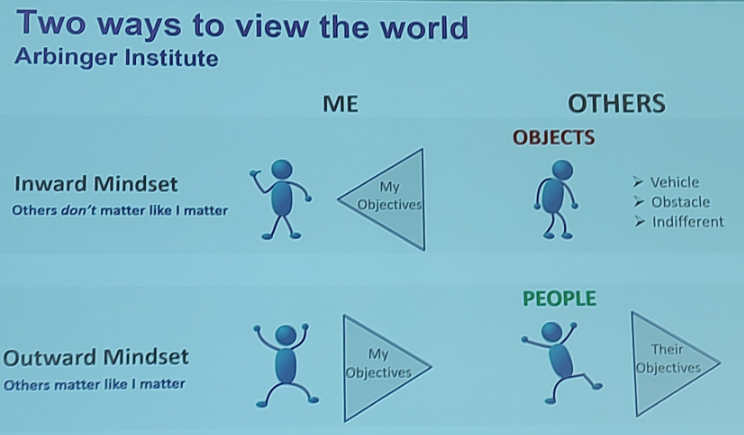
Build connections and collaboration in your organization changing your view to an outward mindset.

The 5 most important words are “How can I help you?”

The 2nd day at the Northeast Lean Conference started with a wonderful presentation from Kevin Hancock, CEO of Hancock Lumber. He described how losing the partial use of his voice to a rare neurological disorder led him to a remote Indian reservation on the northern plains, where he discovered an entire community that did not feel heard. The two events combined to help Kevin realize there were lots of ways for humans to lose their authentic voice in this world. Furthermore, Kevin concludes leaders across time have done more to restrict the voices of others than to honor them.


Kevin took these understandings and developed a new leadership model designed to push power out – away from the corporate center – and give everyone in the organization a leading voice. The result was a high-performing corporate model in which business metrics soared as an outcome of a higher calling.

Leaders create change by becoming the change…

When power is dispersed in an organization, performance improves. Leadership is about giving other people a stronger voice.

There were a number of great presenters at the conference and I only shared a small sampling. Beyond the presentations there is wonderful networking opportunity with like minded practitioners across a number of industries and businesses. GBMP is already working on the next conference.


Save the Date: "It's About Time" on October 3-4, 2023 @ The DCU Center in Worcester MA.


Subscribe to my feed Subscribe via Email LinkedIn Group Facebook Page @TimALeanJourney YouTube Channel SlideShare

Friday, September 30, 2022

Lean Quote: The Secret to Delighting Customer is Putting Employees First

On Fridays I will post a Lean related Quote. Throughout our lifetimes many people touch our lives and leave us with words of wisdom. These can both be a source of new learning and also a point to pause and reflect upon lessons we have learned. Within Lean active learning is an important aspect on this journey because without learning we can not improve.


"Your number one customers are your people. Look after employees first and then customers last.  —  Ian Hutchinson

Of course, the customer remains king, but employees are the ambassadors of a brand. Whether the employee approaches the customer with a smile or with a sigh makes a big difference in the customer experience. After all, the employee is supposed to put the customer first, but if this employee is not happy with his or her work, this will inevitably reflect on the customer.

The time has come to work on enriching the employee experience just as we do the customer experience. It’s all about giving them a feeling of fulfillment and joy. Without that experience – one that evokes an emotion, a memory, some identity – employees will simply view their paycheck as a commodity; no different than bread at the supermarket.

You cannot have employees without customers or customers without employees. It’s like the chicken and egg conundrum: they both came first. Customers and employees are inextricably linked. Burning your employees out at the expense of customers’ satisfaction, as an example, throws that balance out of whack; its a losing proposition that you cannot sustain.

When you take care of your employees, they will naturally take care of your customers. Rather than making your customers the top priority in your company, make your employees the focus. An employee who is satisfied and sees how much you value their work will, in turn, take care of your customers.

Conversely, if you put your customers above your employees, you might wind up hurting those customers in the long run. Employees who see that you care more about the clients they serve than you do about them will not provide the same level of customer service. They will cut corners and care less. Make sure your employees are happy and provided with the tools they need to succeed and the rest will take care of itself.

Work on your employee experience, and those employees will be able to better deliver a quality customer experience.

Putting employees first has great value that cannot be overstated.

Subscribe to my feed Subscribe via Email LinkedIn Group Facebook Page @TimALeanJourney YouTube Channel SlideShare

Wednesday, September 28, 2022

Lean Roundup #160 – September 2022


A selection of highlighted blog posts from Lean bloggers from the month of September 2022.  You can also view the previous monthly Lean Roundups here. 


Rethinking Strategy – Bob Emiliani shares new book Wheel of Fortune about  learning how to improve the process of developing business strategy, executing business strategy, and learning from strategy failure.


Robot Day – Bruce Hamilton talks about all thing AI and how it related to continuous improvement and elimination of waste or not.


How The Project Charter Evolves – John Knotts explains that a Project Charter should not be created and then tucked away inside of a filing cabinet or drawer but needs to evolve with the team.


A Simple Plan for Starting Your Lean Journey – Steve Kane shares 4 steps to point you in the right direction to get started by focusing on fundamentals.


The 7 Cs: Characteristics of a Leader to Create a Chain of Learning – Katie Anderson looks at the 7Cs of impactful leadership allowing you to approach problem-solving – and achieving needed outcomes while developing people –  in the most intentional way possible.


This is NOT Lean: Lean Staffing – Christopher Roser explains that “lean staffing” is actually not a lean thing and does not show respect for people.


A Mystery Solved! That Photo I Use to Talk About Standardized Work and Workarounds – Mark Graban discusses standardized work and the many workarounds people create.


10 Tips for Getting the Most Value from Value-Stream Mapping - Judy Worth shares 10 key things to keep in mind for ensuring your organization reaps the performance gains it can deliver — including improvements in performance and teamwork.


How Purpose Shapes Culture – Richard Sheridan reflects on the struggles and rewards of building a leadership culture that elevates human energy.


Why Coaching is a Core Skill of a Lean Leader – John Shook says if "learning by doing" at the gemba is the best way to learn lean thinking and practices (and it is), coaching is THE skill leaders need to enable more effective, more efficient learning.


Expanding the Purpose of Catchball – Josh Howell explains how catchball helps get the job done while building capability simultaneously.


The lean answer to uncertainty - Michael Ballé says in the face of uncertainty, when it’s hard to see the road ahead, we can still make things better day after day by embracing kaizen – until we are out of the woods.


Subscribe to my feed Subscribe via Email LinkedIn Group Facebook Page @TimALeanJourney YouTube Channel SlideShare

Monday, September 26, 2022

Lean Tips Edition #193 (#3106 - #3120)

For my Facebook fans you already know about this great feature. But for those of you that are not connected to A Lean Journey on Facebook or Twitter I post daily a feature I call Lean Tips.  It is meant to be advice, things I learned from experience, and some knowledge tidbits about Lean to help you along your journey.  Another great reason to like A Lean Journey on Facebook.


Here is the next addition of tips from the Facebook page:

Lean Tip #3106 – Think Differently

Ideas for change can come from a process or policy that you have come across that may be improved or appears to be no longer fit for purpose. Choose something you and others genuinely care about. Keep it simple; you are testing small scale change not trying to do ten things at the same time. You may decide to do a project against a known standard; but this will be a real-time, dynamic audit with the real possibility of making a difference in a short space of time rather than the traditional approach we have become used to.

Lean Tip #3107 – Be Clear and Focused

Have a clear vision and objectives so everyone understands what you are doing and why. Using SMART goals (which are specific, measurable, achievable, relevant, time-bound) should help you achieve this.

Articulate your vision and try to find the hook that makes them want to get involved as well. For example, what new skills they may acquire and the rewards for participating, such as team recognition or leadership.

Lean Tip #3108 – Make a Change and Evaluate it to See if it Worked

Use a straightforward measuring process so there is no doubting the improvements made. It's important to know the baseline activity before you start so you have a number of points of comparison and keep measuring little and often. Two data points are not enough. Record your results on a run chart so you can see the changes taking place over time.

Lean Tip #3109 – Engage Your Team

Improvement is a team activity. Therefore, an essential step in getting started is to engage in dialogue with your team. Make time to talk about what matters to people and involve them in solutions. No one person has the skills or knowledge to come up with a solution on their own. Identify the benefits to the team, customers, and employees, which will help with buy-in. If you don’t have buy-in from your team, you will likely fail, no matter how good your idea is.

Leaders must actively support and make time for improvement processes, in order for it to take hold and flourish. Enable your team to openly share information and encourage people to take action where it’s needed. As a leader, you can create a culture where your team feels connected and empowered.

Lean Tip #3110 – Commit to Change 

Most importantly, you need to enjoy the experience. Lean makes change a real possibility, which is both empowering and satisfying for everyone. Finally, don’t worry about what you don’t know or it being perfect the first time. You will learn by doing and your skills will be developed as you go.  Celebrate your successes and your failures, as there is valuable learning in both.

Lean Tip #3111 – Take a Tour

Sometimes we learn best by first witnessing the success of others. See the benefits of lean in action. It is not difficult to find organizations that will allow you to see their lean implementations (referred to as the Gemba walk). Take detailed notes of what is highly effective in their Lean implementations, ask questions, and get as much valuable information as you can in order to help you formulate you own Lean strategy for implementation.

Lean Tip #3112 – Discard Conventional Fixed Ideas

Part of problem solving is thinking “outside of the box.” Encourage fresh perspectives and ingenuity in your team in order to develop innovative ways to forward Lean manufacturing without changing what is already efficient and successful. With such a rapidly evolving climate in manufacturing, sometimes conventional thought is what leads to the problem in the first place!

Lean Tip #3113 – Provide the Right Supplies, Tools, and Training

Although it’s often taken for granted that a shop floor has what it needs, I’ve seen facilities where employees have to rummage through dumpsters to get simple supplies like grinding discs. From bad documents to missing parts, dropped balls are rampant in almost every industry. By correcting this problem with the right materials, tools, information, training, and work environment, a wide array of inefficiencies will simply evaporate. Your employees will jump to support any good-faith efforts that eliminate the inconveniences they experience.

Lean Tip #3114 – Enlist Believers.

A system-wide change must be powered by team members at all levels of the organization, not just upper level leaders.

The best lean implementations are mandated and supported top-down and put in place bottom-up by enabling the people who do the work to redesign and improve their work.

Find and enlist an army of recruits who will work under the guidance of your leadership team. They will establish the systems and processes that enable both structural and behavioral change.

Lean Tip #3115 – Leave a legacy

Many executives are passionate about what they do and care about making a lasting impact on their organization.

Implementing a process improvement culture can make a real difference to business teams and to the success of an organization. Execs are well-positioned to leave a legacy with the support of engaged teams who are executing processes aligned to the business strategy.

Lean Tip #3116 – Encourage Peer Recognition

Encouraging peer recognition is an effective way to ensure that your employees feel recognized and appreciated for their contributions. Instead of an annual, top-down approach, peer recognition programs empower employees to recognize and reward one another on a much more frequent basis.

Crowdsourcing employee recognition makes celebrating the myriad achievements and contributions of all the members of your team much easier, more organic, more genuine, and much more realistic to accomplish.

Although peer recognition is one of the most effective methods to ensure employees know they're appreciated, there are many other complementary initiatives you can implement that dovetail nicely with it.

Lean Tip #3117 – Highlight Employees When You Can

Whenever you get a chance, highlight your employees. There are a few different ways you can do this. Many companies use social media to highlight employees who are doing something special. Those employees then share that information with their friends and family, so you’ll get more eyes on your brand. This is a win-win for you and your employees. You can also highlight an “employee of the week,” which allows you to recognize employees more often than an employee of the month.

Lean Tip #3118 – Never Underestimate the Value of Sharing Your Time and Building a Relationship With Your Team

They appreciate your genuine interest in their ideas and thoughts about their jobs. They like bouncing ideas back and forth with you and look for your sincere input on their projects and goals.

The role of mentor and coach is powerful in training your organization’s culture and expectations. It is also a significant source of experiential knowledge, history, work approaches, and on-the-job training.

Lean Tip #3119 – Provide Opportunities for Contributing Employees

Opportunities can take many forms. But, all of them are outside of the normal day-to-day requirements of their job plan.

Employees appreciate chances for training and cross-training. They want to participate in a special committee where their talents are noticed. They’d like to lead a team that is pursuing an important objective.

They are happy to attend professional association meetings and proud to represent your organization at civic and philanthropic events. They’d appreciate the green light relative to implementing an idea they have for increasing morale in your workplace.

They are eager to stop doing portions of their job that have become rote in favor of new goals and assignments that stretch their skills and build on their abilities.

Lean Tip #3120 – Recognize the Person, Not Just Their Performance

When we think about the content of a recognition message, we usually associate it with praising an employee's performance. For example: "Great job on exceeding our targets for the quarter!"

But, the problem with only praising performance and productivity is that it can make your message's content feel impersonal.

Ultimately, to boost the impact of appreciation, a recognition message should add a few words about the soft skills they brought to the table. In short, be specific.

"Amazing job exceeding your targets for the quarter! We are so impressed by your creative problem-solving and work ethic."

As you can see, recognition and appreciation messages at work are most impactful when leaders highlight what the employee did differently. When someone sees you and understands you as a person, it's a great feeling.


Subscribe to my feed Subscribe via Email LinkedIn Group Facebook Page @TimALeanJourney YouTube Channel